
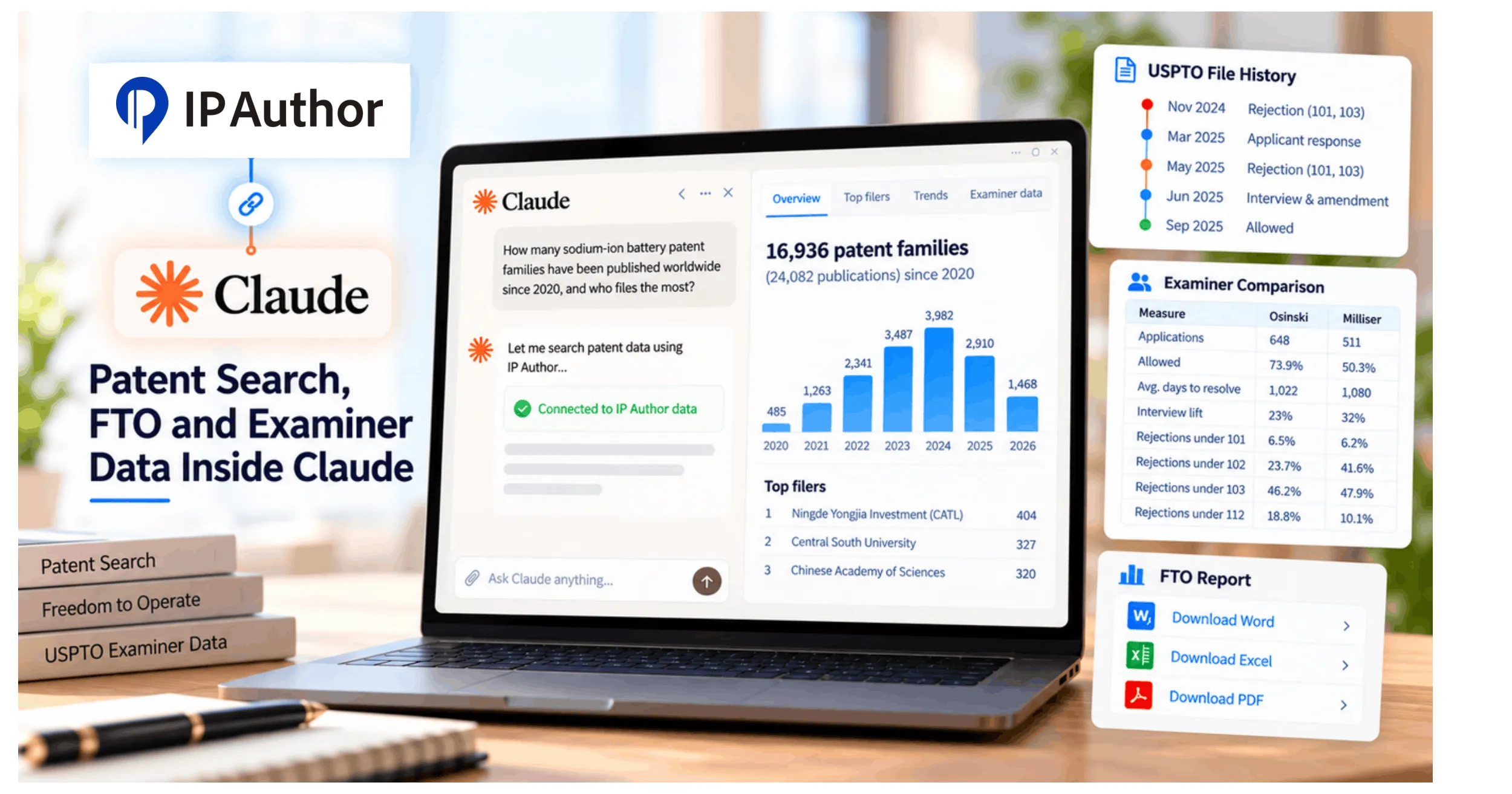
IP Author is now listed in the Claude connector directory. Connect it once, and Claude can answer patent questions from real patent records instead of general knowledge and web pages.
We wanted to know what that changes in practice. So we asked Claude the same patent questions twice: once with web search only, and once with IP Author connected. This post shows what came back.
The short version: with IP Author, Claude gave an exact count, the real reason a patent was allowed, and examiner statistics we could compare. Without it, Claude found fragments and numbers that disagreed.
Patent work needs patent data
Claude is a capable assistant, but it was not built for patent work. On its own it reads the open web. It cannot open a USPTO file history, it has no examiner data, and it cannot give you an exact count of patent families in a field.
IP Author for Claude connects Claude to:
- 183 million patent publications worldwide
- Research papers and other non patent literature for prior art searches
- The official US examination record: office actions, responses and claim amendments
- Examiner statistics, including allowance rates and how examiners handle rejections
Claude still does what it does well, like comparing two references, explaining a claim in plain language, or drafting the email to your client. IP Author supplies the records underneath.
We asked Claude the same questions twice
We ran every question twice. First in Claude with web search only, then in Claude with IP Author connected. Here are three of them.
1. Sizing a technology field
Question:How many sodium-ion battery patent families have been published worldwide since 2020, and who files the most?
Claude found vendor blog posts about narrow slices of the field, such as sodium-ion battery binders (8 families) and separators (11 families), plus older law firm articles. None gave a total for the whole field since 2020, so there was no single number to quote.
16,936 patent families (24,082 publications) since 2020. Filings grew from 485 families in 2020 to a peak of 3,982 in 2024, and 2025 and 2026 are still filling in as applications publish.
China is the first filing office for 94.5% of families, and only 511 families (3%) include a US filing.
The top filer is Ningde Yongjia Investment, which files through CATL, with 404 families. Central South University has 327 and the Chinese Academy of Sciences has 320. Even so, the top three hold only 6% of the field.
14 of the 15 filers we tracked were filing faster in 2023 and 2024 than in 2021 and 2022. Jiangsu Zhengli New Energy Battery Technology grew the most, from 4 families to 76.
2. Finding out how an AI patent got allowed
Question:Summarize the prosecution history of US 12,554,796 (NVIDIA, application 17/334,501). Which rejections did it face, and what got it allowed?
Claude found the published patent text on the USPTO site, but nothing about the rejections or the applicant’s responses. Without the file history, it could not say what the examiner objected to or which arguments worked.
NVIDIA filed the application in May 2021. It covers a way to train neural networks on a carefully chosen subset of training data.
In November 2024 the examiner, Michael S Osinski, rejected all claims as an abstract idea (a mathematical concept) and over Shabtay (US 2021/0342642). NVIDIA answered in March 2025 by pointing to Example 39 in the USPTO’s eligibility guidance.
In May 2025 the examiner kept the eligibility rejection and moved the prior art rejection to Shabtay combined with Byun (US 2023/0085127). After an interview in June 2025, NVIDIA filed a request for continued examination and amended claim 1. It now required adjusting the network’s architecture based on the estimated hyperparameters, then updating the network’s parameters.
The examiner allowed the application in September 2025, and the patent issued on February 17, 2026. The turning point was a narrower claim 1 after the interview, the kind of detail only the file history shows.
The same search also surfaced a second NVIDIA case, where an examiner called receiving, processing and transmitting medical imaging data a mental process. Patent teams can use examples like these to see how eligibility rejections for AI and computing claims actually read.
3. Knowing the examiner before you respond
Question:Compare examiners Michael S Osinski and Theron S Milliser. How often do they allow applications, and what do they reject on?
Claude found statistics for both examiners, but the sites disagreed. For Osinski, one site reported a 93% grant rate and another about 72%. For Milliser, one said 60% and another 48%. Claude did not find a side by side comparison, and nothing explained the gaps or told us which figures to trust.
| Measure | Osinski | Milliser |
|---|---|---|
| Applications | 648 | 511 |
| Allowed | 73.9% | 50.3% |
| Average days to resolve | 1,022 | 1,080 |
| Interview lift | 23% | 32% |
| Rejections under 101 | 6.5% | 0.2% |
| Rejections under 102 | 23.7% | 41.6% |
| Rejections under 103 | 46.2% | 47.9% |
| Rejections under 112 | 18.8% | 10.1% |
Osinski works on image processing in Tech Center 2600. Milliser sits in Tech Center 2800. Their playbooks look very different: Osinski allows far more often and raises more eligibility and section 112 issues, while Milliser leans on anticipation and allows about half of his cases.
Rejection rows show each statute’s share of that examiner’s rejections.
What changed with IP Author
| Task | Claude with web search | Claude with IP Author |
|---|---|---|
| Counting patents in a field | Pieces of the field from vendor blogs, no total | 16,936 families, top filers, trends and geography |
| Why a patent was allowed | The published patent text, no rejections or arguments | Each rejection, the cited art, the amendment and the interview |
| Examiner statistics | Different sites, different grant rates for the same examiner | Allowance rate, rejection mix, interview lift and days to resolve for both examiners |
| Deliverables | Chat text | Interactive reports, claim charts, downloadable Word, Excel or PDF files |
| Explaining, summarizing and drafting | Good at it | Just as good, working from verified patent records |
What you can do with IP Author in Claude
- Check if an idea is new.Describe your invention and get the closest patents and research papers, ranked and explained.
- Check if a product is safe to launch.Run a guided freedom to operate review with ranked risks, open questions, and a downloadable Word, Excel or PDF report.
- Build infringement theories.Match a patent’s claims against a product, using documentation the assistant finds and rates for reliability.
- Size up a technology field.Get exact counts, leading companies, trends, and a full interactive competitive landscape report inside Claude.
- Check standards essentiality.See whether a patent is essential to a standard such as 5G, with the reasons.
- Understand a US application.See its full history, what the examiner cited, how the claims changed, which arguments worked, and how similar rejections were overcome.
- Plan an office action response.Compare options, risks, deadlines and costs, plus a side by side comparison of two examiners.
How to connect IP Author in Claude
Setup takes about a minute.
- Open the IP Author listing in the Claude directory.
- Click Connect to add IP Author to your Claude account.
- Sign in with your registered IP Author credentials when asked.
- Start a new chat and ask your patent question in plain English.
Claude chooses the right IP Author tool for each question, so there are no tool names to learn. On Team and Enterprise plans, an organization owner may need to enable the connector first.
A note on security and data handling
Patent work involves some of the most sensitive material in any practice: invention disclosures, privileged communications and unpublished applications. You connect IP Author to Claude with your own IP Author account, and anything accessed or created through it is covered by the same ownership, security and retention terms as our web app.
Your content is never used to train our models. Data is encrypted in transit and at rest, and IP Author is SOC 2 Type II compliant. For documentation, see our Trust Center and Privacy Policy, or email support@ipauthor.com for our security pack and DPA.
FAQ
What is IP Author for Claude?
It is a connector that lets Claude search and analyze patent data from IP Author, so answers come from real patent records.
Do I need an IP Author account?
Yes. You sign in with your registered IP Author credentials when you connect. If you do not have an account yet, you can start a 14 day free trial.
Can I download the results?
Yes. A freedom to operate review can be downloaded as a Word, Excel or PDF report, and a competitive landscape opens as an interactive report inside Claude.
Can I use IP Author in ChatGPT too?
Yes. IP Author is also available in ChatGPT, with the same patent records. See how it works in ChatGPT.
Get started
Connect IP Author from the Claude directory, ask your first patent question, and see the answer built from real records. New to IP Author? Start a free trial or book a demo.