
Quick answer
An invention disclosure form (IDF) is a confidential internal record that tells your patent team what was invented, by whom, and when. The sections that matter most are how the invention works, variations and failed attempts, past and planned public disclosures, and who contributed. Under US law, the form does not set a priority date, but its records support grace-period and inventorship questions later.
Key takeaways
- Pair a short form with a 30-minute inventor interview. Long forms get skipped or filled in thinly.
- Four sections shape the eventual patent more than the rest: how it works, variations and failed attempts, public disclosures, and contributors.
- The form is internal and confidential. It does not set a priority date or start any legal clock. A public disclosure does.
- US law excuses your own public disclosure for up to one year before filing, but only if your records show what was disclosed, by whom, and when.
- Witness signatures are not legally required, AI tools cannot be inventors, and the attorney decides inventorship against the claims.
Introduction
Most invention disclosure forms fail in the same way. Inventors describe the version they built, skip the alternatives they tried, and forget the conference abstract they submitted last month. The attorney then spends days chasing details, and the application ends up with fewer fallback positions than it should have.
Often the bigger problem is the disclosures that never arrive at all. In a study of close to 4,000 engineers and other innovators at four companies, only about a third engaged with their company’s formal invention submission process (Chien and Grennan, UC Berkeley).
This guide is for patent attorneys, patent agents, and in-house IP teams filing at the USPTO. It gives you a free invention disclosure form template, shows which sections matter most, lists the questions to ask inventors, and explains what the form does and does not do under current US law.
Free invention disclosure form template
Download the free template: Invention Disclosure Form Template
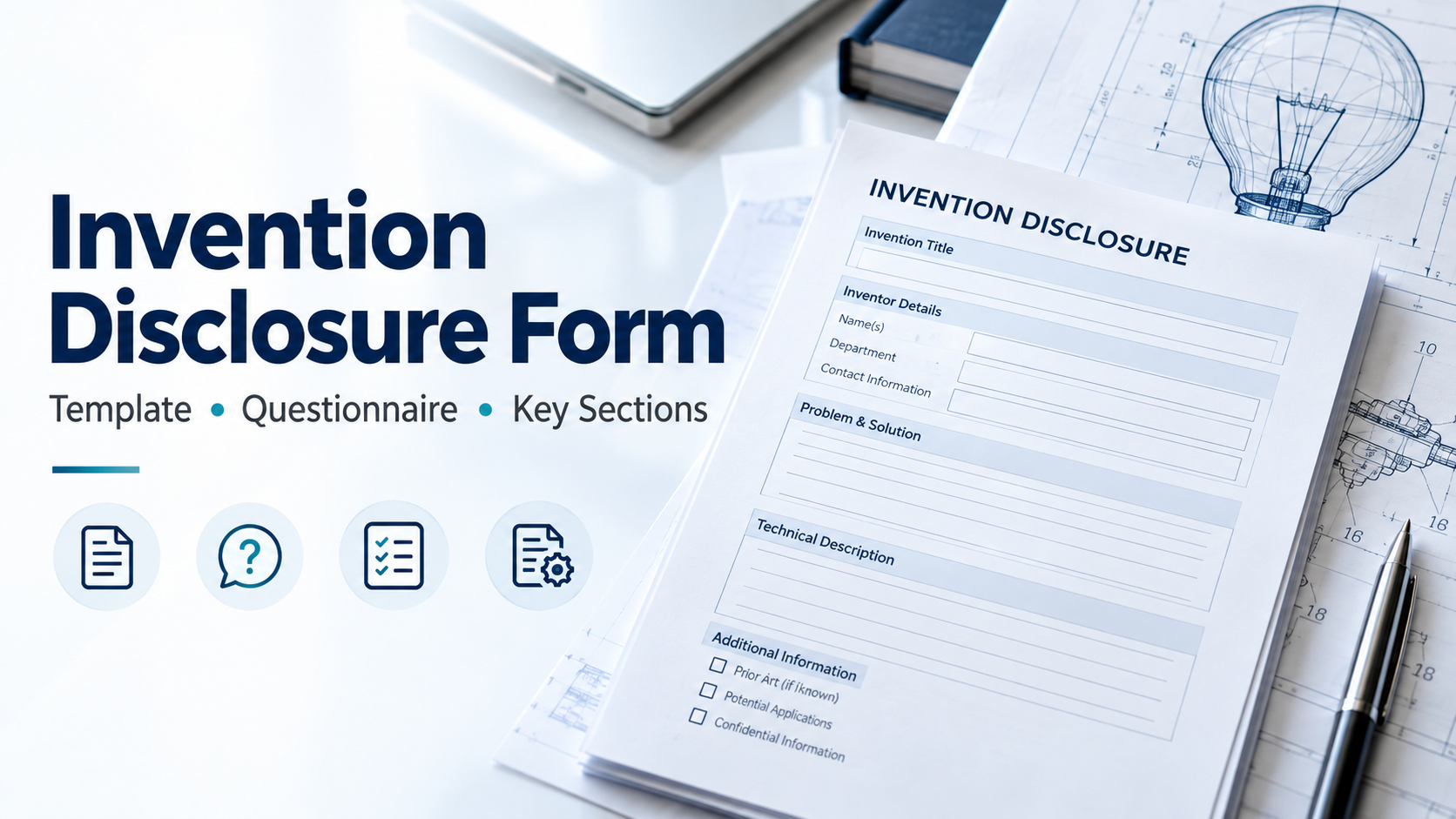
The template has two parts. Section A is for inventors and takes about 30 minutes. Section B is for the IP team and keeps the evaluation record with the disclosure. Law firms can send Section A to clients as an intake form and keep Section B as the matter record.
What’s in the form:
- Section A, for inventors (16 fields): title; inventors and contributions; non-confidential summary; problem and current solutions; how it works; what is new; variations, alternatives, and failed attempts; known prior art; key dates; public disclosures, past and planned; funding and agreements; commercial context; use of AI tools; stage of development; where the invention was made; inventor confirmation.
- Section B, for the IP team (8 fields): disclosure number and dates; assigned attorney or agent; deadlines, including any planned public disclosure and the one-year grace period; interview notes; initial search; evaluation; decision (file, publish defensively, trade secret, hold, or close); decision reasoning.
What to include, and which sections matter most
Most templates give every field equal weight. They are not equal. If inventors only do a good job on four sections, make it these.
1. How it works
Ask for a step-by-step description, at least one working example, the ranges that still work, and the preferred setting. Drawings with numbered parts help more than paragraphs. The drafter needs enough detail to write claims at more than one level of breadth, and to support them in the specification.
2. Variations and failed attempts
This is the most useful section on the form and the one most often left blank. Inventors naturally describe the version they built. The alternatives they considered become dependent claims and fallback positions, and the approaches that failed help explain why the solution was not obvious.
3. Public disclosures, past and planned
This is the field most likely to cost you rights. Conference abstracts are often submitted months before the talk and then forgotten. Ask for every paper, poster, talk, preprint, demo, customer meeting, and offer for sale, with dates. Any planned disclosure in the next few weeks should go straight to the attorney.
4. Contributors
List everyone who may have contributed an idea, including people at partner organizations. The attorney decides legal inventorship later. Missing a contributor is far easier to fix at intake than after a patent issues, and incorrect inventorship can put a patent’s validity at risk.
The other sections
The rest still matter, but a short answer is usually enough:
- Title and non-confidential summary, for routing and review.
- Problem and current solutions, in a few sentences.
- What is new, with any data that shows the difference.
- Known prior art, including the inventors’ own earlier work.
- Key dates: first idea, first written record, first build or test.
- Funding and agreements. If federal funding was involved, the inventor’s written disclosure can start a two-month deadline for reporting the invention to the funding agency under the Bayh-Dole regulations.
- Commercial context, including whether a competitor’s use could be detected.
- AI tool use, stage of development, and where the invention was made.
Questions to ask inventors
A form captures what inventors think to tell you. A 30-minute interview captures what they did not. These questions do most of the work.
How it works
- Walk me through it step by step, as if I were a new engineer on your team.
- Which parts are essential, and which are just how you happened to build it?
- What ranges still work, and what is the best setting?
What is new
- In one sentence, what is the new part?
- What is the closest thing you have seen, and how is yours different?
Variations and design-arounds
- What else did you try, and why did it fall short?
- If you were a competitor, how would you get the same result without copying you?
- If a competitor used this, how would we find out?
People and timing
- Who contributed ideas, as opposed to carrying out instructions?
- Have you shown or described this to anyone outside the company, or do you plan to? When?
- Did you use AI tools? What did they produce, and what did you decide or change?
Hypothetical example: why the follow-up matters
This example is hypothetical and for illustration only.
An engineer submits a disclosure for a battery thermal-management method. The “How it works” field says: “A controller reduces charging current when cell temperature exceeds 45 °C.” That is one embodiment with one number.
In the interview, the attorney asks what ranges still work and what else was tried. The engineer explains that thresholds from 40 °C to 50 °C were tested, that a rate-of-temperature-rise trigger worked better in cold climates, and that a fixed charging schedule was dropped because it shortened battery life. Each answer gives the drafter a potential dependent claim or fallback position that the form alone would have missed.
Why invention disclosures go wrong
Ideas never reach the IP team. Many engineers never engage with the submission process at all, so promising ideas stay in notebooks and design docs. What helps: make submitting easy, and have the IP team reach out to engineering teams directly instead of waiting for disclosures to arrive.
Inventors don’t know what counts. When UC Berkeley researchers asked engineers at one tech company why they had never submitted an idea, the top answers were that they didn’t think they had a patentable idea (30%) and that they didn’t understand the process (24%) (AEA RCT Registry). What helps: plain-language prompts, a filled-in example, and a clear message to submit even when unsure.
Disclosures arrive thin. Inventors describe what they built and stop there, which leads to weeks of back-and-forth before drafting can start. What helps: a structured interview or guided questions like the ones above.
The process is scattered. Disclosures sit in email and shared drives, different teams submit overlapping ideas, prior-art search starts late, and detail gets lost before the first draft. What helps: one system that tracks each disclosure from intake to draft.
What the form does and does not do under US law
Many templates online still carry advice from before the America Invents Act. Here is where things stand now.
It is internal, not public. The form goes to your IP team or outside counsel, not to the USPTO, and there is no official USPTO invention disclosure form. Sharing it in confidence is not a public disclosure. Publishing, presenting, demonstrating, or offering the invention for sale is, and that is what affects patentability.
It does not set a priority date. For applications with claims effective on or after March 16, 2013, the US is a first-inventor-to-file system. The filing date is what counts, so file as soon as the invention is ready rather than relying on dated records.
Its records still matter for the grace period. Under 35 U.S.C. 102(b)(1), an inventor’s own public disclosure made one year or less before the effective filing date is not prior art against the inventor. The USPTO lets applicants identify these disclosures and, when needed, rely on declarations to show where a disclosure came from (MPEP 2153). That only works if someone recorded what was disclosed, by whom, and when. Treat the grace period as a safety net, not a plan.
It helps with inventorship, but does not decide it. Each named inventor must have contributed to the conception of at least one claim, so inventorship is decided against the claims, by the attorney. The form’s job is to make sure no contributor is missed.
AI tools cannot be inventors. Only natural persons can be named. The USPTO treats AI as a tool, so the form should record what the humans contributed.
Witnesses are not legally required. Older templates insist on witness signatures because they mattered under first-to-invent. Today, witnessing or reviewer sign-off is a company policy choice. Timestamped electronic submissions do the same job of corroborating records.
Filing outside the US too?
The US grace period only helps in the US. Many other jurisdictions, including Europe, treat your own earlier publication as prior art, so if foreign filing is possible, file before any public disclosure. For inventions made in the US, a foreign filing license is generally required before filing abroad (35 U.S.C. 184). We will cover European requirements in a separate guide.
What happens after submission
Most IP teams follow the same path once a disclosure arrives:
- Log it. Assign a number, confirm receipt, and check for urgent deadlines such as a planned publication.
- Interview the inventors using the questions above.
- Search. Run an initial prior-art search to test novelty and sharpen what is new.
- Evaluate technical strength, commercial value, detectability, and portfolio fit.
- Decide: file (often a provisional first), publish defensively, keep as a trade secret, hold, or close.
- Hand off to drafting, with the disclosure, interview notes, and search results.
Disclosure quality shows up again at the drafting stage, as review time. When a draft is built from a thin disclosure, the attorney has to fill gaps, check each passage against what the inventor actually meant, and rewrite sections that guessed. For many attorneys, that review is where AI drafting loses its time savings: checking work you do not trust can be slower than writing it yourself. Better input does not remove attorney review, but it cuts the rework that makes review slow.
AI can support most of these steps, from guided intake to AI prior art search and AI-assisted patent drafting, as long as attorneys make every legal judgment. For a closer look at that hand-off, see how AI converts raw invention input into patent-ready claims.
IP Author’s Invention Management module is built around the problems described above:
| Problem | How the Invention Management module addresses it |
|---|---|
| Inventors are unsure what to submit or how | Guides inventors through attorney-aligned questions, much like an attorney-inventor interview, instead of a blank form |
| Thin disclosures and repeated follow-ups | Questions are designed to surface key technical elements without repeated follow-ups |
| Disclosures scattered across email and drives | Keeps all IDFs tracked in one place |
| Overlapping ideas from different teams | Flags likely duplicates with similarity checks |
| Prior-art search starts long after intake | Links each disclosure to prior-art search |
| Detail lost between disclosure and draft | Tracks versions as the disclosure moves toward a filing-ready specification |
It does not replace the attorney’s judgment on patentability, inventorship, or filing strategy. It gives the attorney better input to make those calls.
Invention disclosures are highly sensitive, so review any vendor’s security commitments before you use it. IP Author’s are in its Trust Center.
Did you know?
In November 2025, the USPTO rescinded its 2024 guidance on AI-assisted inventions in its entirety and stated that there is no separate or modified inventorship standard for inventions made with AI. The same conception-based test applies whether or not AI tools were used (Federal Register, 90 FR 54636). That is why recording what the human inventors contributed is now a standard part of a good disclosure form.
FAQ
What is an invention disclosure form?
An invention disclosure form (IDF) is a confidential internal document in which inventors describe a new invention, who contributed, key dates, and any public disclosures, so the IP team can decide whether and how to protect it.
Is there an official USPTO invention disclosure form?
No. Invention disclosure forms are created by companies, universities, and law firms. The USPTO receives patent applications, not internal disclosures.
Does an invention disclosure need to be witnessed or notarized?
Not under US law. Some organizations require a witness or reviewer signature as internal policy.
Does submitting an invention disclosure count as a public disclosure?
No, as long as it is shared in confidence with the IP team or counsel.
When should an invention disclosure be submitted?
As early as possible, and always before any paper, talk, demo, or offer for sale.
Who decides who the inventors are?
The patent attorney or agent, based on who contributed to the conception of at least one claim.
Can AI help write an invention disclosure?
Yes, as a tool. AI can guide inventors with structured questions and organize their answers. Inventors must be natural persons, and confidential details should only go into tools with appropriate security controls.
Conclusion
A good invention disclosure form does three jobs. It records who invented what and when. It flags the deadlines that can cost rights, above all planned public disclosures. And it gives the drafter the detail, variations, and fallbacks a strong US application depends on. Keep the form short, put the effort into the four sections that matter most, and use the interview to capture the rest.
Turn disclosures into draft-ready input
IP Author’s Invention Management module guides inventors through attorney-aligned questions, organizes their answers into a structured disclosure, and connects it to prior-art search and drafting, with attorneys in control at every step. Start a 14-day free trial or book a demo to see it with your own disclosure workflow.
This article provides general information about US patent practice as of October 2026 and is not legal advice. Confirm specifics for your situation with qualified patent counsel.