

Patent work needs patent data
ChatGPT is a capable assistant, but it wasn’t built for patent work. It searches the open web, not a patent database. It can’t read USPTO file histories, it has no examiner data, and it can’t give you an exact count of anything. Ask it how many patent families have published in a field, which arguments got a patent allowed, or how often an examiner allows applications, and you’ll quickly run into the limits.
IP Author for ChatGPT changes that. Add the plugin once, and ChatGPT can work with:
- 183 million patent publications worldwide, grouped by patent family
- Research papers and other non-patent literature for prior art searches
- The official US examination record: office actions, responses and claim amendments
- Examiner statistics, including allowance rates and how examiners handle rejections
The plugin gives you IP Author’s research and analysis tools. For drafting, teamwork and saved projects, use the full IP Author platform.
Where it helps in your patent work
We built the plugin around the three moments when patent teams most need hard data: before filing, before a product launches, and during prosecution.
Before you file
Prior art and novelty
Ask“Find the closest prior art for a foldable phone hinge that uses an eddy-current magnetic damper.”
You getA ranked list of patents and research papers, with a note on what each reference covers and what it is missing.
Before a product launches
Freedom to operate
Ask“Run a US freedom to operate check for this product.”
You getIn-force and pending patents that could be a risk, a claim-by-claim reading of the closest ones, a list of checks for anything still open, and a report in Word, Excel or PDF. Nothing is marked clear without product evidence.
Evidence of use
Ask“Build an evidence of use chart for claim 1 of this patent against this product page.”
You getA claim chart with product evidence for each element and a reliability rating for every source.
Landscape
Ask“How many solid-state battery electrolyte patent families have published since 2020, and who are the top filers?”
You getAn exact count, the leading filers, filing trends and an interactive report.
Standards
Ask“Is this patent essential to 5G NR?”
You getA reasoned view of whether the patent maps to the standard.
During prosecution
Office action analysis
Ask“Here’s the latest office action on my application. What are my response options?”
You getResponse options with risks, deadlines and costs, based on the file history and what has worked with this examiner.
Prosecution history
Ask“What happened during prosecution of US application 17/309,329?”
You getEach rejection, the references cited, the claim amendments and the argument that got the patent allowed.
Examiner data
Ask“Compare examiners Theron S. Milliser and Tom V. Sheng.”
You getAllowance rates, rejection patterns, interview impact and average time to allowance for each examiner.
ChatGPT with and without IP Author
We asked plain ChatGPT (with no plugins) and IP Author the same questions. Here is what we found.
| Task | ChatGPT on its own | ChatGPT with IP Author |
|---|---|---|
| Prior art search | Searches the open web, mostly Google Patents pages. The list changed when we asked twice, and there are no filters for date, classification or legal status. | Searches 183 million patent publications and research papers, ranks the closest references, and explains what each one teaches and lacks. |
| Counting patents in a field | Couldn’t give a number. It quoted another vendor’s report instead. | An exact count (20,297 families), with top filers, filing trends and a full landscape report. |
| Prosecution history | Found the public dates and issued claims, but couldn’t say which arguments won without the USPTO file. | The full file history: each rejection, the references cited, the claim amendments and the arguments that got the patent allowed. |
| Examiner data | Found numbers for one examiner and marked every figure for the other as not verified. | Allowance rates, rejection patterns and interview impact for both examiners. |
| Freedom to operate | A short list of possible patents from the web, marked as a preliminary screen. | Reads the claims element by element, lists the checks needed to settle open points, and produces a downloadable report. |
| Deliverables | Chat text. | Reports and claim charts you can download as Word, Excel or PDF. |
| Explaining, summarizing and drafting | Good at it. | Just as good, but working from verified patent records. |
Below are three of the questions we tested. Each one is something patent attorneys need often: an exact count of patents in a field to show a client, the real reason a patent got allowed, and data on the examiner before you respond to an office action. Plain ChatGPT could not fully answer any of them, because the answers sit in patent records and USPTO files it can’t reach. IP Author answered all three from those records.
1. Counting patents in a field
QuestionHow many patent families on solid-state battery electrolytes have been published worldwide since 2020, and who are the top 5 filers?
ChatGPT said it couldn’t verify a worldwide total. It pointed to another vendor’s report covering 2015 to 2026 and said a precise number would be misleading.
20,297 patent families (48,818 publications). Samsung leads with 1,249 families, followed by Toyota (915), LG (803), Panasonic (735) and CATL’s parent company (386). Samsung’s filings grew from 23 families in 2017 to 400 in 2024.
2. Finding what got a patent allowed
QuestionSummarize the prosecution history of US application 17/309,329 (Google, US Patent 12,001,247). What did the examiner cite, how did the claims change, and which arguments overcame the rejections?
ChatGPT gave the key dates and the issued claims. Its list of examiner citations came from the patent’s general citation list and even included an old conveyor belt patent. It said it couldn’t tell which arguments won without the USPTO file.
The examiner first rejected the claims over Robinson (US 11,079,807). In a July 2023 interview, the examiner agreed that placing the hinge at the bendable section of the display would overcome that rejection, and Google amended claim 1. The examiner then issued a final rejection adding Kato (US 2018/0059740). Google filed a request for continued examination with one more limitation, that the display rests against both types of hinge segment when unfolded, and the patent issued in June 2024. The key moment was the interview, where the examiner said which amendment would work.
3. Comparing examiners
QuestionCompare US patent examiners Theron S. Milliser and Tom V. Sheng. How often do they allow applications, and how do they handle 103 rejections?
ChatGPT found some numbers for Milliser on the web, but couldn’t verify a single figure for Sheng, so it wouldn’t compare them.
Milliser allows about 50% of his 510 applications. Sheng allows about 91% of his 935. 103 rejections make up 48% of Milliser’s rejections and 36% of Sheng’s. Interviews matter much more with Milliser (a 32% lift) than with Sheng (8%), and Milliser’s cases take longer on average, 1,080 days against 818.
Why bring IP Author into ChatGPT
One of our users told us how his day went before this: run a search in IP Author, copy the results into ChatGPT, ask it to compare and summarize, go back to refine the search, and paste the new results in again. Plenty of patent professionals now do their reading and writing in ChatGPT, and the patent data lives somewhere else.
The plugin puts the two in one conversation. IP Author supplies the records, the counts and the file histories. ChatGPT does what it’s good at on top of them, like comparing two references, explaining a claim in plain language, or drafting the email to your client.
A note on security and data handling
Patent work involves some of the most sensitive material in any practice: invention disclosures, privileged communications and unpublished applications. You connect the plugin with your own IP Author account, and anything accessed or created through it is covered by the same ownership, security and retention terms as our web app. Your content is never used to train our models. Data is encrypted in transit and at rest, and IP Author is SOC 2 Type II compliant.
For documentation, see our Trust Center and Privacy Policy, or email support@ipauthor.com for our security pack and DPA.
Getting started
You’ll need an IP Author account. If you don’t have one yet, you can start a 14-day free trial or book a demo.
Setup takes about a minute:
- In ChatGPT, click Plugins in the left sidebar.
- Search for “IP Author” and click +.
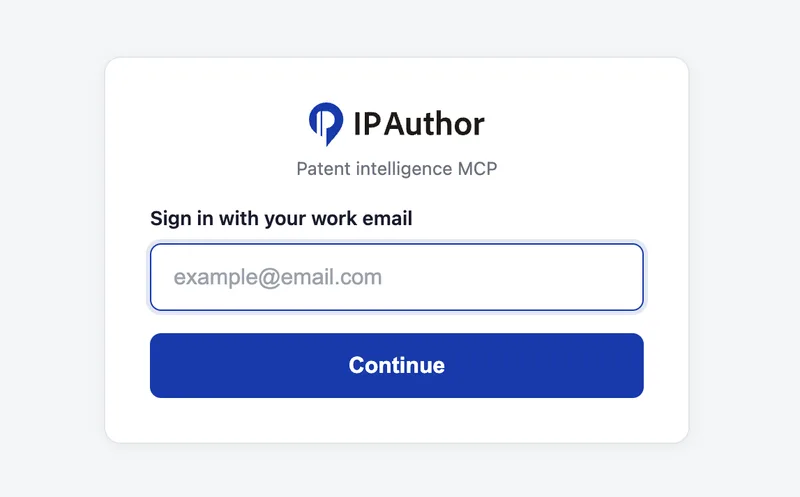
- Sign in with your work email, enter the 6-digit code we send you, and click Allow.
- Open a new chat and ask your question. Starting with “Using IP Author,” makes sure ChatGPT picks it up.

If you get stuck, email support@ipauthor.com and we’ll walk you through it. Prefer Claude? IP Author works there too. Here’s how to connect it. And if your firm builds its own AI tools, talk to us about connecting IP Author to them.
Plugin or web app?
The ChatGPT plugin is an extra way in for people who already work in ChatGPT. It gives you IP Author’s research and analysis tools inside your chat. For the full experience, including patent drafting, team collaboration and saved projects, work directly in the IP Author platform.
IP Author for ChatGPT is available today
Already an IP Author user? Add the plugin from ChatGPT’s Plugins page. New to IP Author? Try it free for 14 days or see it in a live demo.