
A patent’s commercial value is rarely decided in the initial drafting. It is won or lost in the Office Action response. That is where prosecution history estoppel is born, and claim scope is either surgically defended or inadvertently signed away.
For most prosecution teams, the bottleneck is not the legal reasoning. It is the structural work that has to happen before the reasoning can even begin. Confirming the right claim language, reconstructing the examiner’s mapping logic, verifying cited references, and maintaining consistency across every section of the response. IP Author’s latest release addresses each of those friction points directly.
Four updates, now live in IP Author, each targeting a specific place where the current workflow slows attorneys down or introduces unnecessary risk.
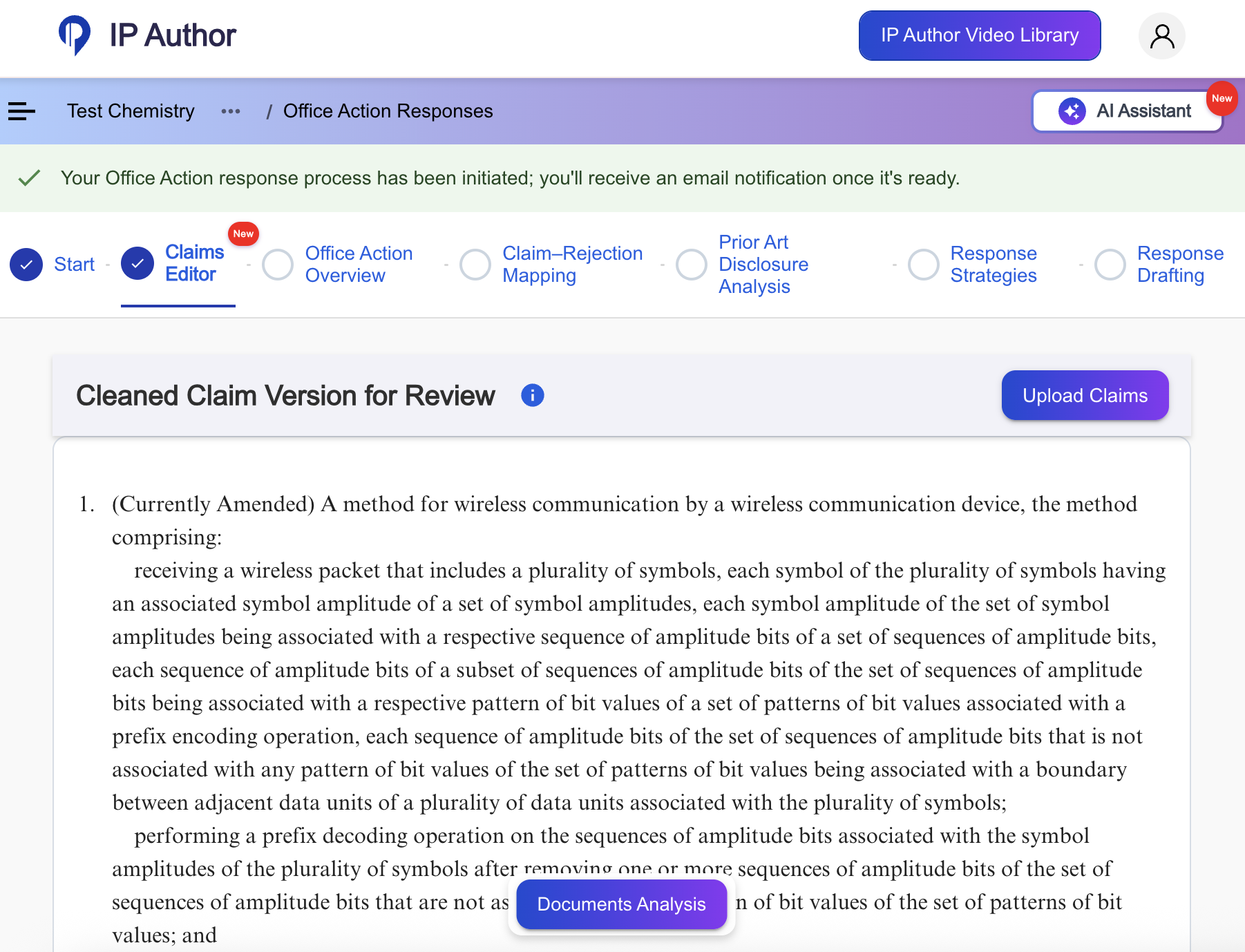
1. Claim Editor: Lock the Foundation Before Arguments Begin
In any Office Action response, the claims are the starting point. If you are working from the wrong version, every argument you build on top of that is at risk. And this is easier to miss than it sounds, especially after multiple amendment rounds or when more than one person is working on the same matter.
The Problem This Solves
IP Author now requires attorneys to confirm the current claim set before any drafting begins. The Claim Editor puts the claims in front of you for review. You lock them. That confirmed version becomes the foundation for every argument, every amendment, and every strategic decision that follows. Nothing downstream gets built on an assumption.
There is also a practical escape valve. The USPTO-processed version of your claims does not always match what you have on file. It is not common, but it happens. If it does, you can upload your own version directly as a PDF or Word document. The platform reads it and treats it as the confirmed baseline going forward.
What This Means for Your Practice
- Every argument gets built on claims you have personally reviewed and confirmed
- No version surprises discovered at the end of a response cycle
- Upload support for PDF and DOCX when the USPTO version needs to be overridden
- Consistent claim foundation across multi-attorney matters where version discipline is hardest to enforce
2. Chemistry Office Action Support: One Platform for Every Technical Discipline
Chemistry prosecution has always been the odd case out. Pharmaceutical and speciality chemical matters required separate handling, independent tracking, and a different analytical approach. Teams have worked around this for years by routing these cases outside the standard workflow.
That workaround is no longer necessary.
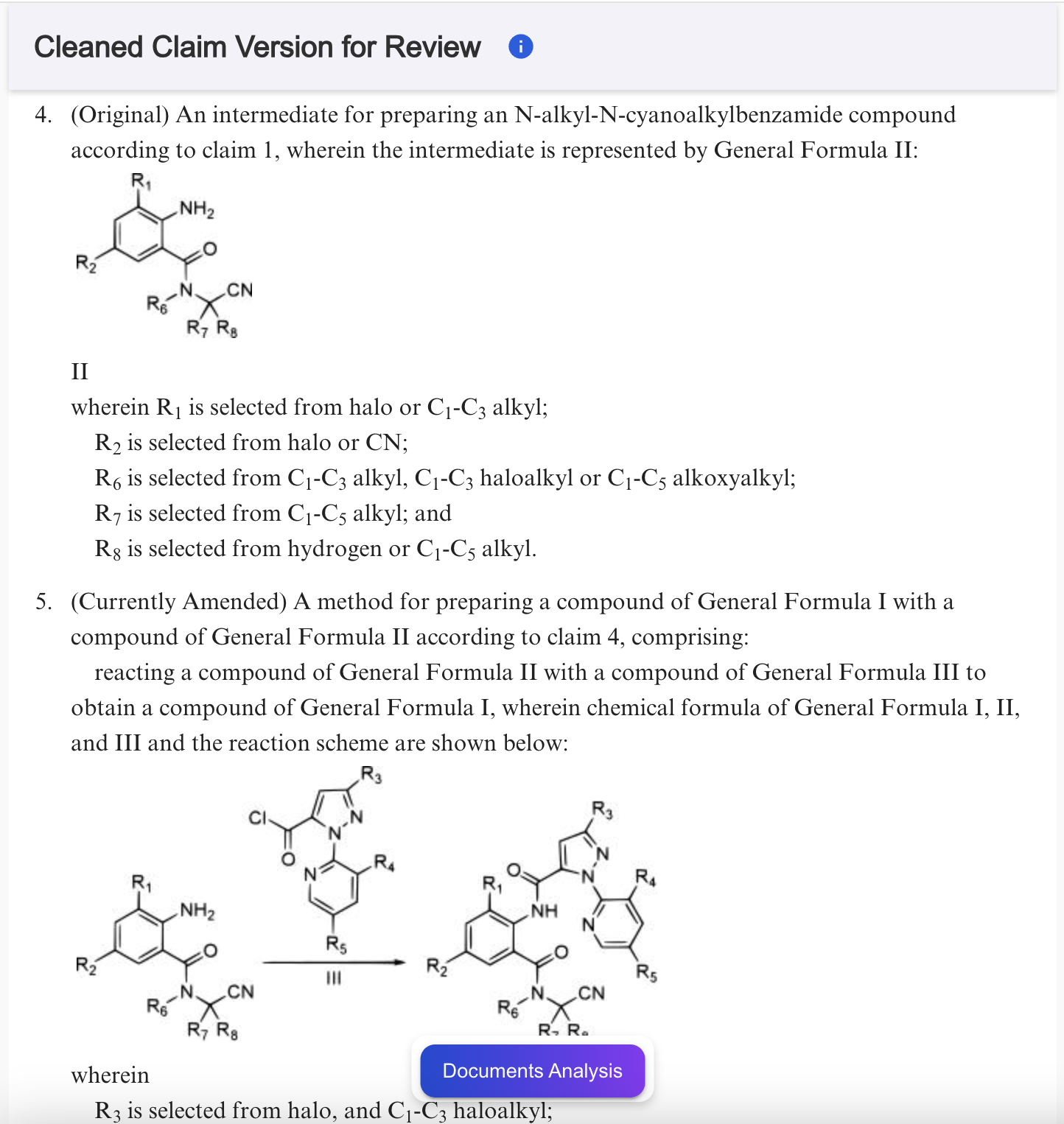
IP Author now supports Chemistry Office Actions within the same structured workflow used for software, mechanical, and biomedical cases. For prosecution teams handling pharmaceutical or speciality chemical matters, this means everything runs through one platform with one record.
Why Chemistry Is Different and Why That Matters
What the Platform Now Does
- Processes chemistry-specific claim language including Markush groups and genus/species distinctions
- Maps examiner objections based on structural analogs directly to the claimed structure and functional limitations
- Evaluates database-based novelty and obviousness rejections as structural comparisons, not simple text matches
- Recognises SMILES, MOL, and SDF chemical structure formats uploaded directly, displayed as-is without distortion
- Identifies core scaffolds, substitution positions, and structural features relevant to claim differentiation
- Supports Markush-style claim drafting with full platform integration
3. European Office Action Analysis: Structured Mapping, Single Workspace
EPO examination is precise by design. Every objection is built around a specific document, a specific passage, and a specific claim element. Getting to a response requires knowing exactly which claims are being challenged, which passages the examiner relied on, and where the argument needs to be constructed.
In practice, that mapping work has always fallen to the attorney. Pulling the examiner’s narrative apart, rebuilding it as a structured picture of which reference addresses which claim, locating the relevant passages. It is careful and necessary work. It is also exactly the kind of structural groundwork the platform can take on.
The Structural Groundwork Is Now Handled Before You Begin
What This Changes in Practice
- Novelty objections are mapped to specific claims and passages automatically, without manual reconstruction
- Inventive step challenges are presented with clear citation-to-claim traceability before any strategy work begins
- The legal analysis stays with the attorney; the structural groundwork moves to the platform
- All analysis runs within a single workspace, so there is no need to cross-reference between the examiner's letter, the cited documents, and separate notes
4. Universal Chatbot in the US Office Action Workflow: Context-Aware Assistance Without Leaving the Platform
US Office Action practice requires continuous evaluation. You are not just interpreting the examiner’s reasoning. You are also pressure-testing claim language, checking specification support, exploring amendment paths, assessing fallback positions, and thinking through how each response decision will shape the prosecution record downstream.
That analytical process generates questions at every stage. And until now, finding the answers meant leaving the platform.
The Agentic Layer: What It Actually Does
What You Can Do Inline
- Ask why the examiner cited a particular reference and identify exactly which passage they relied on
- Request a structural comparison between the examiner's cited compound and your claimed structure
- Explore how a proposed amendment would affect overall claim scope and prosecution history
- Validate specification support for any claim limitation without leaving the drafting environment
- Check antecedent basis, claim structure, and whether key aspects of the invention are fully captured
- Paste in your own draft response and ask the system to check it against the examiner's position
- Ask about statutory standards, fallback positions, and how a proposed revision may shape the record going forward
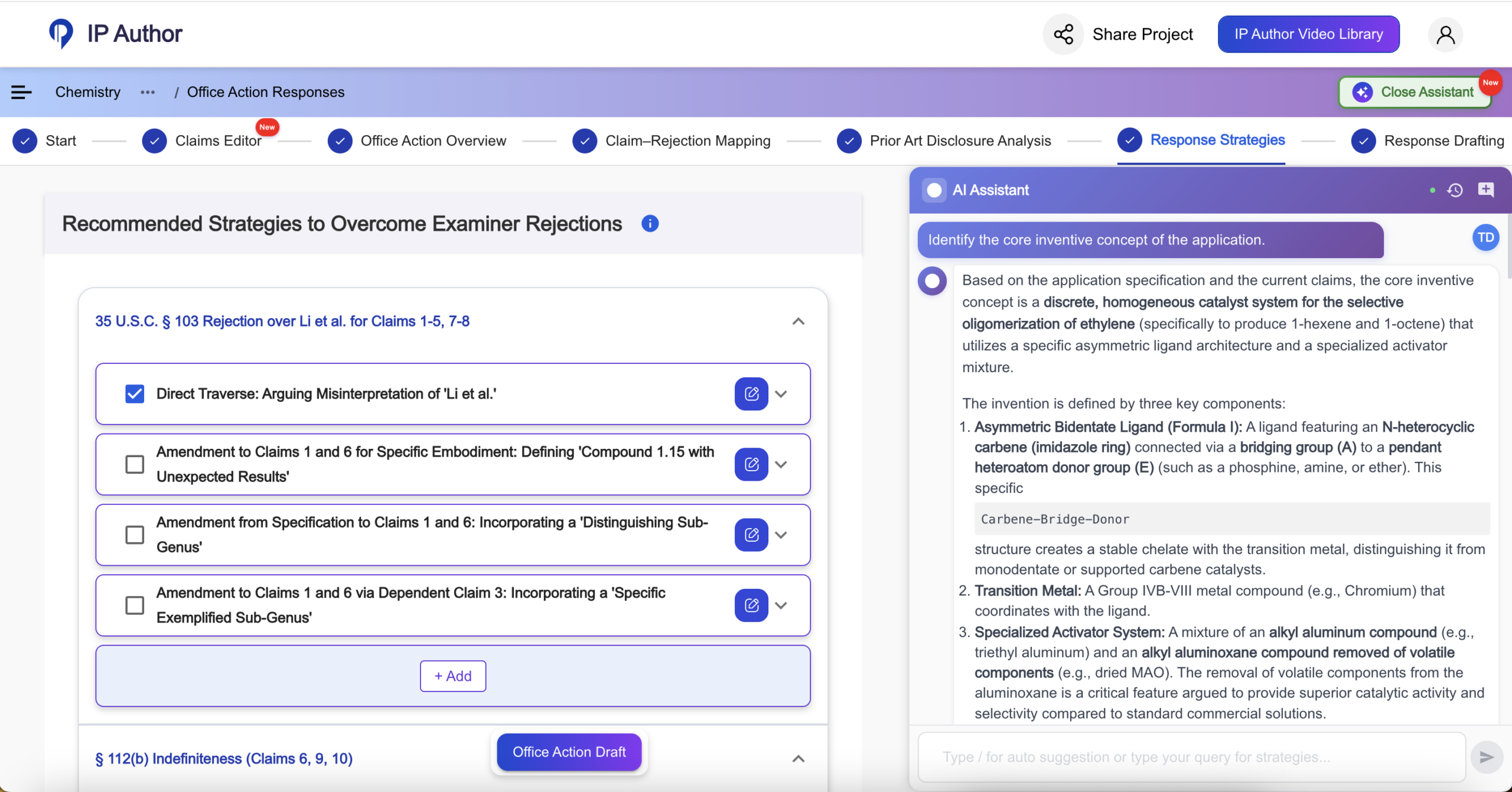
A Prosecution Scenario: How These Four Updates Work Together
Step 1: Lock the Claims (Claim Editor)
Step 2: Clarify the Examiner's Position (Universal Chatbot)
Step 3: Build the Chemistry Response (Chemistry Support)
The platform maps the examiner’s cited compound against the claimed structure and highlights the structural differences that matter. It also surfaces the functional limitation in the confirmed claims, specifically the performance threshold the drug must meet, that the examiner’s obviousness analysis does not account for. The attorney can see clearly where the examiner’s argument falls short and build the response around those distinctions, all within the same workflow.
The Result
Before and After: At a Glance
| Before | After IP Author Update |
|---|---|
| Claims were treated as a given, rarely confirmed, often misaligned with what the system was using to generate responses. | Claims are explicitly confirmed and locked before strategy generation begins. Every downstream argument is anchored to a verified, attorney-approved claim set. |
| Chemistry Office Actions required separate handling outside the standard workflow, with independent tracking and review cycles for each case. | Chemistry Office Actions run through the same structured workflow as all other technical disciplines. One platform, one record, full case type coverage. |
| European Office Action objections had to be manually mapped from examiner narrative to specific claims and cited passages before any analysis could begin. | Novelty and inventive step objections are presented with clear citation-to-claim visibility. The structural mapping is done by the platform before analysis begins. |
| Clarifying examiner rationale or reference mappings meant leaving the platform, breaking the analytical thread of the response being built. | Context-aware assistance is available inline within the US Office Action workflow. Claims, rejections, and cited references stay in view throughout drafting. |
What This Means for Your Practice
Each of these four updates solves a specific problem in the Office Action response process. They are not incremental interface improvements or cosmetic changes to the workflow. They are structural changes to where analytical work happens and who does it.
Confirming claims before drafting begins means arguments are always built on the right foundation. Chemistry support means pharmaceutical and speciality chemical cases are handled in the same place as everything else. Structured European analysis means attorneys spend their time on strategy rather than rebuilding the examiner’s mapping from scratch. The Universal Chatbot means questions get answered inline, without losing the thread of the response being drafted.
Taken together, they reflect one consistent principle: IP Author should handle the structural work so attorneys can focus on the legal judgment.