
In 2022, the phrase "large language model" appeared in 107 patent applications worldwide. In 2025 it appeared in 29,538.
None of that is controversial. What matters is what happens to a search string written before the shift. It still runs. It still returns results. It just stops returning the right ones, and it does it without telling you.
Below are seven numbers from the patent record. Not one of them is a change in the law. Each is a change in behaviour that quietly retired an assumption most workflows still run on.
Your search is looking for the wrong words
Put those 29,538 filings next to "neural network", the term most AI patent searches still default to. It hit 138,929 global filings in 2025.
LLM related language is already at about 21% of the volume of the term everyone actually searches for, from a standing start three years ago.
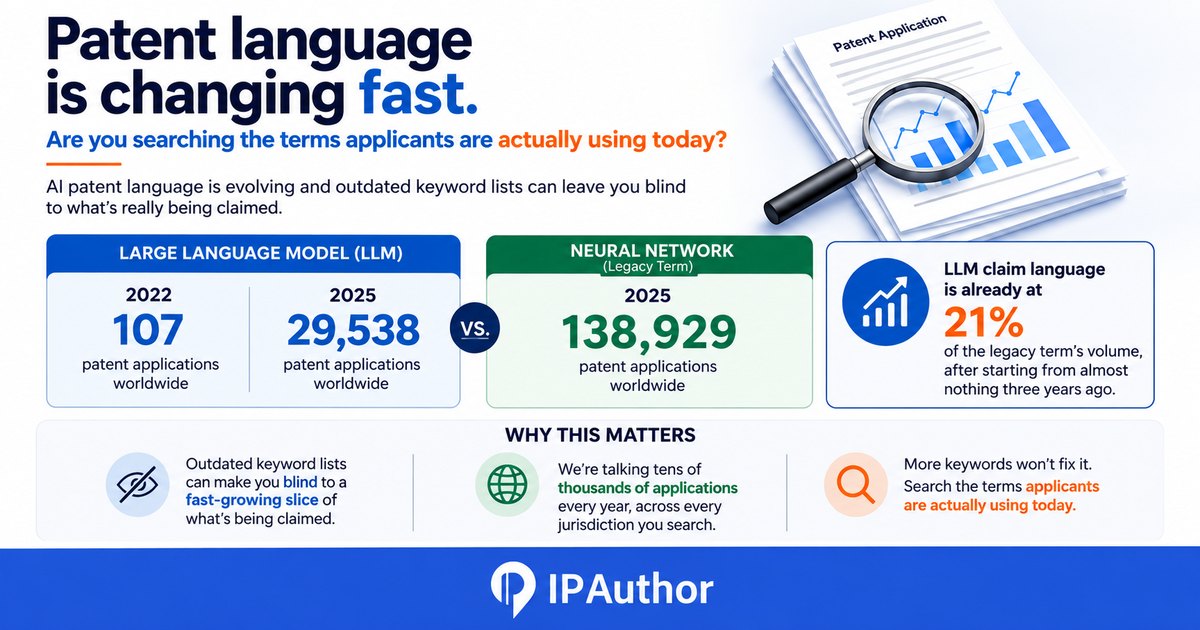
If your freedom to operate or prior art search runs on a keyword list written even two years ago, you are blind to a fast growing slice of what is actually being claimed right now. Adding more keywords does not fix this. The terms applicants use keep moving, and a static list keeps falling behind.
The same problem shows up in classification rather than vocabulary. In 2024, 5% of medical device patents in A61B also carried an AI or machine learning classification in G06N. In 2015 that figure was 0.25%. That is 21x growth in nine years, 8,962 dual classified patents out of 170,141, against 247 out of 98,512 back in 2015.
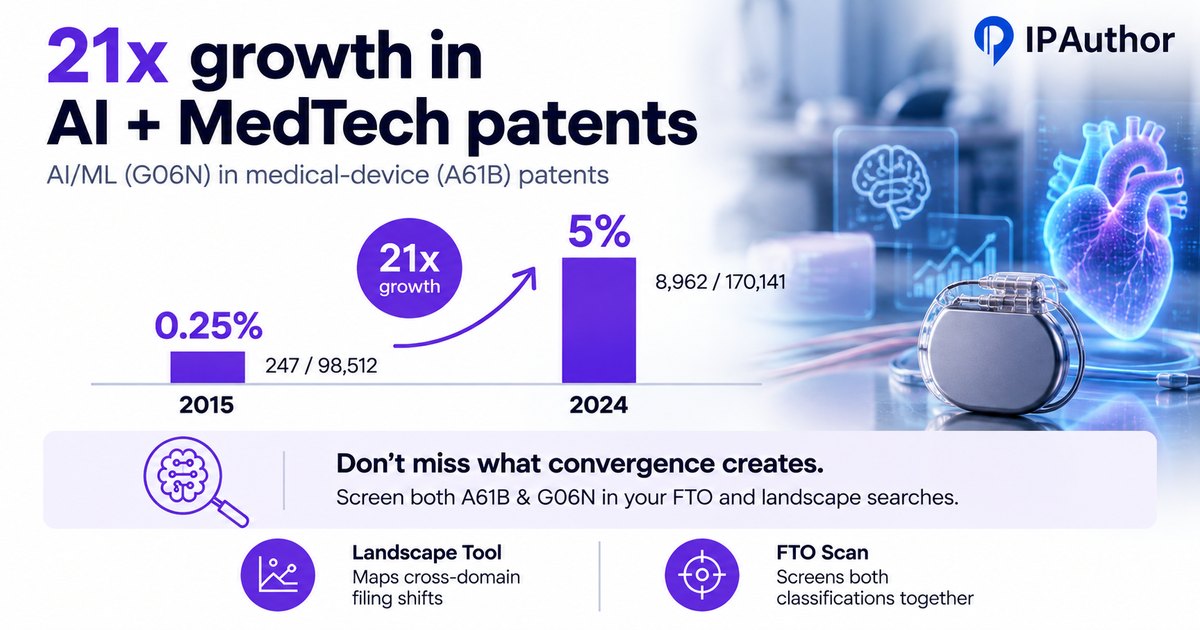
Siemens, Philips, J&J, Medtronic, GE Healthcare, Canon and Samsung are all filing across both classes already. If your medtech clearance search covers A61B and stops there, a convergence this size slips straight past it.
The patent you found may not be the risk you think
Of the 100.3 million patents we tracked, 4.36 million have changed ownership at least once. Roughly 1 in 23 overall. But the average hides the useful part.
| Technology area | Reassignment rate |
|---|---|
| Semiconductors | 14.4% |
| Pharma | 12.8% |
| Software | 11.3% |
| Mechanical | 7.0% |
Semiconductor patents reassign at more than double the mechanical rate and roughly three times the corpus wide average.
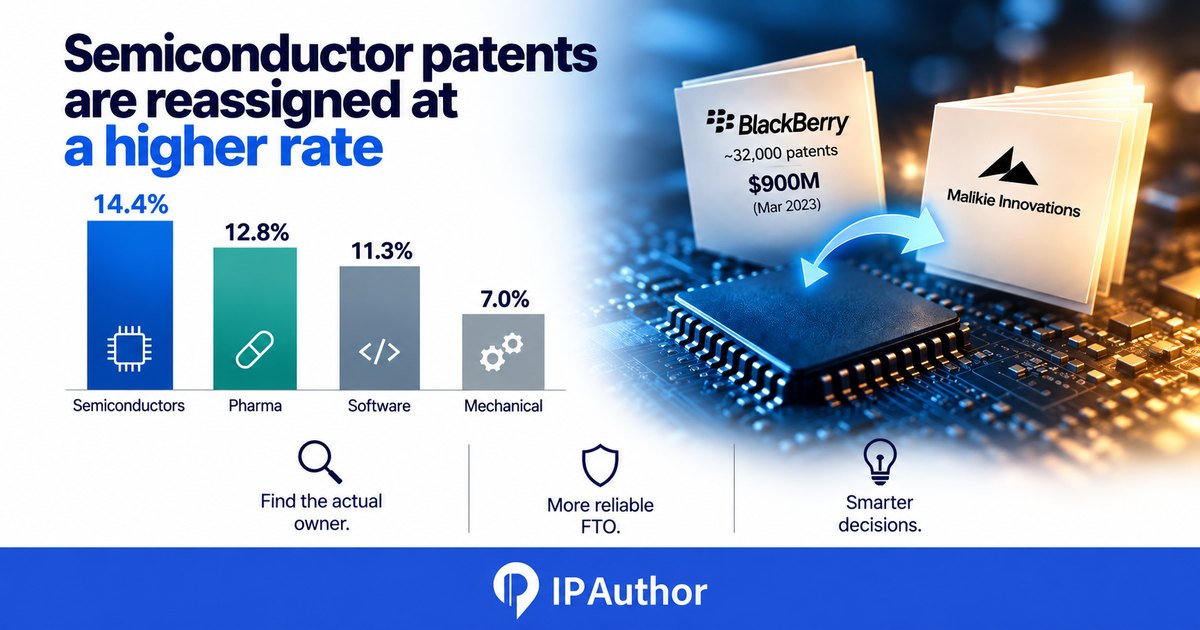
The pattern is clearest in electronics and telecom, and it moves in very large blocks. In 2023 BlackBerry sold roughly 32,000 patents to Malikie Innovations for up to $900 million, covering mobile, messaging and wireless networking. Years earlier the remaining Nortel derived portfolio held by Rockstar Consortium went to RPX Clearinghouse for another $900 million.
The company that filed a patent may not be the company that owns it today. That matters most exactly where ownership churns fastest, which is where a lot of clearance work happens.
Ownership is one signal. Family size is another, and it is a better predictor of trouble than most people expect.
Of more than three million patents in wireless and networking under H04L, only 13,394 have ever been litigated. That is roughly 0.4%. But that slice looks nothing like the rest. Litigated patents sit in families averaging 26 members, against 5.9 for everything else, a 4.4x gap.
In Meta v Voxer, the patent Voxer asserted, US 8,180,030, had a family of 119.
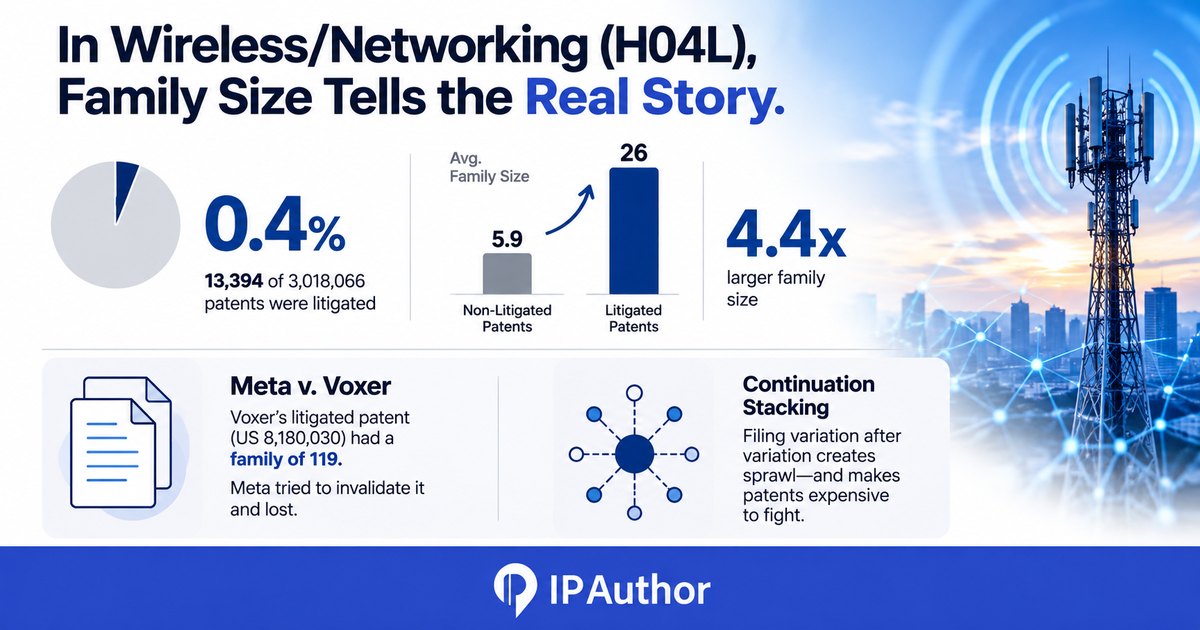
A lot of that comes from deep continuation stacking, filing variation after variation off one disclosure. That sprawl is often exactly what makes a patent expensive to fight, and it is easy to check before you are the one on the wrong side of it. When you are clearing a product or sizing up a competitor, family size is worth watching as closely as citation count.
The cost of prosecution has shifted
Continuation heavy strategies now carry friction they did not used to.
In 2012, 20,419 of 268,085 US patents needed a terminal disclaimer. Roughly 1 in 13, or 7.6%. By 2020 that had risen to 35,280 of 295,833, nearly 1 in 8, or 11.9%. A 57% increase.
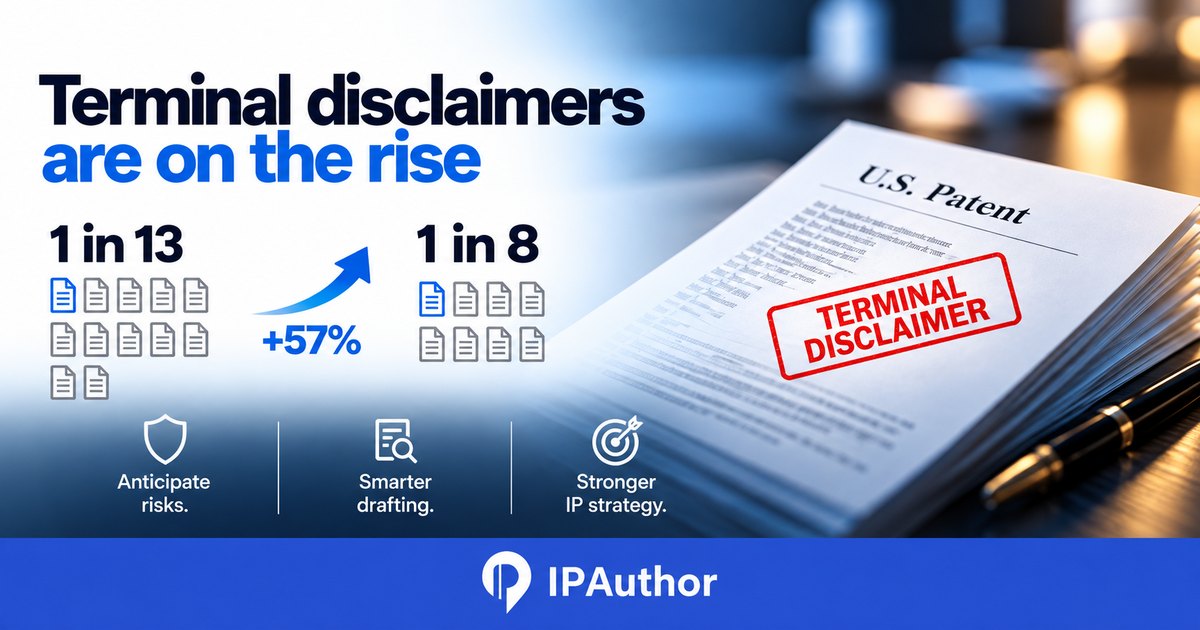
AbbVie is the familiar example. It kept filing closely related patents on how Humira is made, mostly years after the drug launched, to keep competitors out longer. That is exactly the kind of strategy that draws double patenting rejections and needs terminal disclaimers to resolve.
If you are managing a continuation heavy portfolio, this is now a normal cost of the strategy rather than an edge case. Plan for it before you file, not after the rejection lands.
The other shift is in what examiners actually hit AI claims with.
70% of Alice rejections for AI inventions come through the "mental process" path, which is 10% over the Alice baseline. Examiners are barely using the "math concept" path at all, at 4%, well below the baseline.
That is a drafting instruction, not a statistic. When you write an AI claim, and most of us are writing very little else these days, make sure the examiner can see that the claimed process cannot run in a human mind. Focus on scale, training data volume, model parameters in the billions, and computational steps in the hundreds or more.
The rejection you should be braced for is not the one most people prepare for.
And the map is still being drawn
The last one is less about defending a position and more about spotting where positions are being taken.
Nvidia has 1,215 patents that explicitly mention "digital twin", concentrated in computer graphics under G06T and computer vision under G06V, tied to world models. A GPU company is building a defensible IP position around the virtual worlds where robots and factories get trained before they touch anything real.
Now the part that makes it interesting. State Grid Corporation of China holds 1,241 digital twin patents, focused on power infrastructure, transformers, transmission lines and grid modelling.

Same underlying technology. Two entirely unrelated industries. Near identical patent volumes.
For an IP team the question is not whether Nvidia is doing digital twins. It is which of your competitors are quietly patenting the infrastructure of a market that does not fully exist yet, and where the white space still sits.
What these have in common
None of these is a change in the law. Every one of them is a change in behaviour, visible in the filing record before it shows up anywhere else. Applicants started using new words. Portfolios changed hands. Continuation strategies ran into a wall. Examiners settled on one line of attack over another.
All of it is checkable. Most of it is not checked, because the assumption it invalidates was safe the last time anyone looked.
IP Author's landscape tool maps filing trends, technology clustering and white space for any market you are tracking. The FTO scan resolves patents to their current owner rather than the original assignee, and screens across converging classifications together.
For examiner behaviour and rejection patterns, the analytics sit at insights.ipauthor.com.