
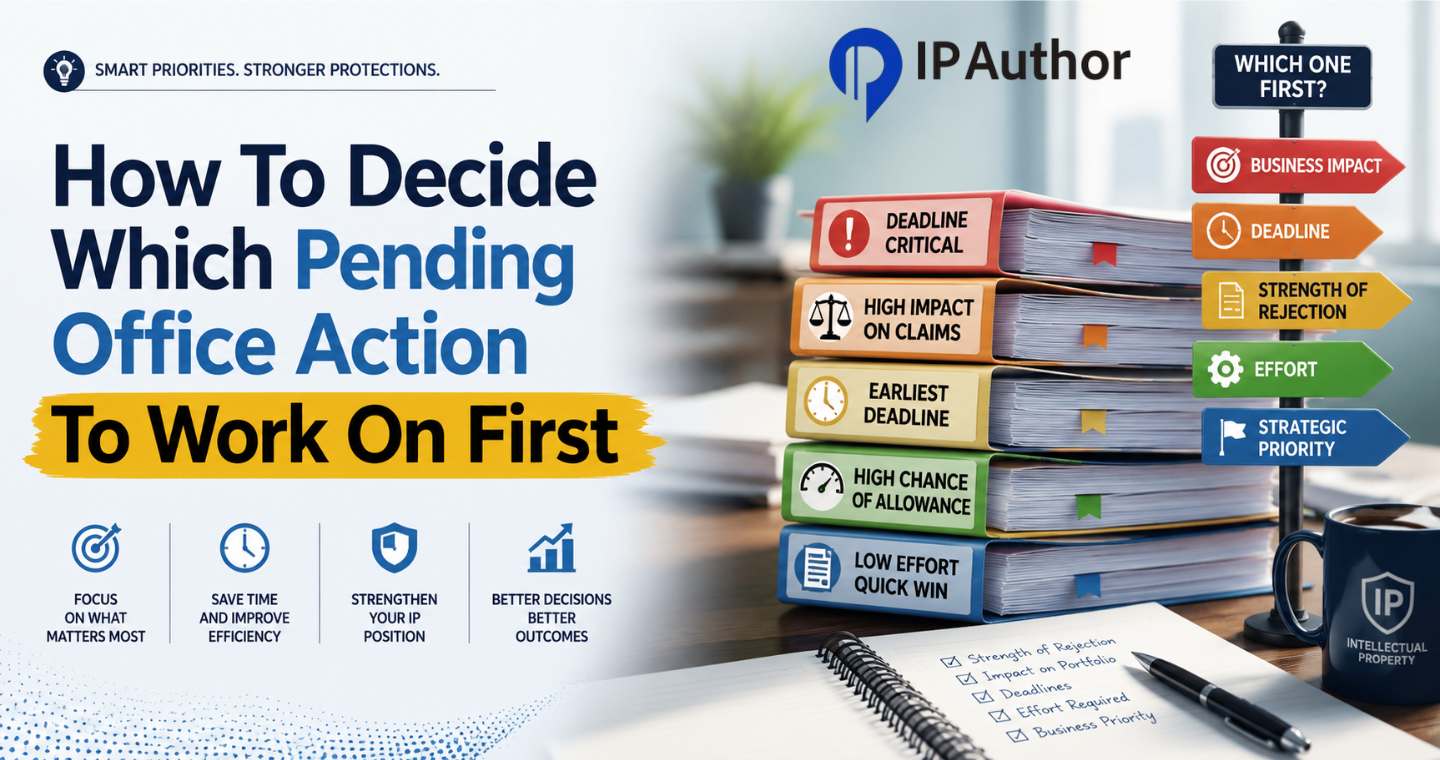
A practical framework for IP portfolio managers, layering portfolio intelligence on top of deadline management. Illustrated with one real public company's docket.
It's Monday morning. Your in-house IP team is sitting on 925 pending office actions. Three of them are due Friday. Forty-seven are due in the next two weeks. Hundreds more are stacking up behind them. You have a finite number of attorneys and an effectively infinite to-do list.
Where do you start?
Most IP teams answer the same way: work the closest deadline first. That instinct is right, and should stay right. Deadlines are not optional. Missing a USPTO response date can mean abandonment, and that is not a trade-off any portfolio manager wants. Deadline-based triage is, and should remain, the guardrail.
The argument here is not that deadline-based triage is wrong. It is that portfolio intelligence can be layered on top of deadline management, so that teams keep protecting against missed dates while also surfacing quick wins, higher-leverage matters, and resourcing patterns that pure deadline-order work tends to obscure.
What deadline-only triage tends to miss
Deadlines tell you what is urgent. They do not, on their own, tell you what is winnable, what is strategically important, or where your team's time is most likely to compound.
When teams work strictly in deadline order, with no portfolio layer on top, three patterns tend to emerge:
- The team spends its best hours on whichever OA happens to land on top of the stack, regardless of how hard it will be to overcome or how much the underlying claim matters to the roadmap.
- Winnable cases get buried behind unwinnable ones. A §103-only rejection in front of a high-allowance examiner may get the same attention as a multi-statute §101 fight in front of an examiner who has historically denied similar art.
- Quick wins can slip. These are cases that are technically overdue but reasonably closeable with a short response or a short examiner interview, and they tend to be invisible on a pure deadline list.
The deadline is still the guardrail. It is just one of several dimensions that can drive smarter triage inside the space the deadline allows.
A simple framework: deadline × complexity × business value × external dependency
Think of every pending office action as living on four axes:
Axis 1
Deadline pressure
How soon must we respond? Are extensions still on the table? This is the guardrail.
Axis 2
Complexity
How statutorily messy is the rejection? §103 alone is usually navigable. §101 + §112 + §103 is a different fight entirely. Who is the examiner, and what is their allowance rate on cases like ours?
Axis 3
Business value
Does this claim actually protect a shipping product, a roadmap feature, or a licensing position? Or is it a defensive filing whose grant is "nice to have" but not load-bearing?
Axis 4
External dependency
Who outside the in-house prosecution team has to touch this matter before it can be filed? A response needing an inventor declaration, fresh inventor input, foreign associate instructions, or client review of a draft has a real start date that sits earlier than its USPTO due date. By contrast, a response that needs no client or external feedback, and is straightforward on its face, can reasonably be started later in the window, even with a close nominal deadline.
The point of this fourth axis is practical: the official USPTO deadline is not always the only timing driver. External-dependency lead time is what determines when work actually needs to start, and that is the calendar a prosecution team is really working against.
Smart triage ranks all four dimensions together rather than letting any one dominate.
What this looks like in practice
Let's ground this with a real public company. Intel Corporation currently has 925 pending US office actions, spread across 240 art units and 700 examiners. Here is what the portfolio looks like when you layer portfolio intelligence on top of the deadline list:
Pure deadline triage puts them all at the top, and the genuinely deadline-critical ones still belong there. But not all 436 are equal: the data suggests 51% of Intel's docket is "hard" (§101-driven or multi-statute), and those are not the cases a team typically wants to rush under deadline pressure.
These sit in front of examiners with allowance rates above 80%, are rated Easy or Medium difficulty, and could plausibly be closed in hours rather than days. They are a candidate for Monday-morning attention each week, alongside (not instead of) the genuine deadline-criticals.
Examiner Courtney P. Spann alone has 8 pending Intel applications, with a 79.8% allowance rate and a +21.9% interview lift: historically, when applicants on this examiner's docket request an interview, allowance rates have run nearly 22 points higher than on otherwise-comparable applications without interviews. One possible implication is that batching interviews with this examiner could be a higher-leverage move; the portfolio view is what makes that pattern visible.
Knowing the difficulty mix lets a team staff proactively by type rather than reactively by which OA hit the deadline list first. That last point is the quiet upside of portfolio-level data: staff by type rather than OA-by-OA, while still honoring every deadline.
The quick-win habit, alongside the deadline list
If your team takes one thing away, let it be this: once the week's genuine deadline-criticals are accounted for, find the quick wins next.
In Intel's case, the 9 candidate quick-win cases (high allowance rate, easy/medium difficulty, examiner intelligence already mapped) are sitting in the docket waiting to be closed. The earliest is 29 days overdue. A morning of focused work, after the true deadline-criticals are handled, could plausibly clear them. Each closure shifts a pending case to a granted patent, frees a docket slot, and builds momentum heading into the harder fights.
This is a portfolio-management principle, not a tool-specific insight. But it is almost impossible to act on without a view that ranks all pending OAs simultaneously by examiner, statute, difficulty, and external-dependency lead time, rather than one matter at a time.
Start with the deadline list. Then layer the portfolio view on top.
This piece is not arguing "stop working deadlines." Deadlines are, and should remain, the guardrail. The shift is adding a portfolio-level layer on top, so that within the space the calendar allows, the team can act on quick wins, batch interview-receptive examiners, route §101-heavy work to senior attorneys, and start externally-dependent matters early enough that inventor input or foreign-associate sign-off does not become the bottleneck.
That layer does not require new attorneys, new processes, or a software rollout. It requires a portfolio-level view the team actually looks at on Monday mornings.
If you want to see your own company's pending office actions ranked this way (by complexity, examiner behavior, deadline pressure, external-dependency considerations, and quick-win potential) IP Author's Prosecution Insights tool is free to browse. Look up your portfolio at insights.ipauthor.com, and start your next Monday with the deadline list and a triage layer on top.
Want a live walkthrough?
Book a 15-minute session and we'll triage your specific portfolio together.
Book a session