
By Samir Raiyani · 4 min read
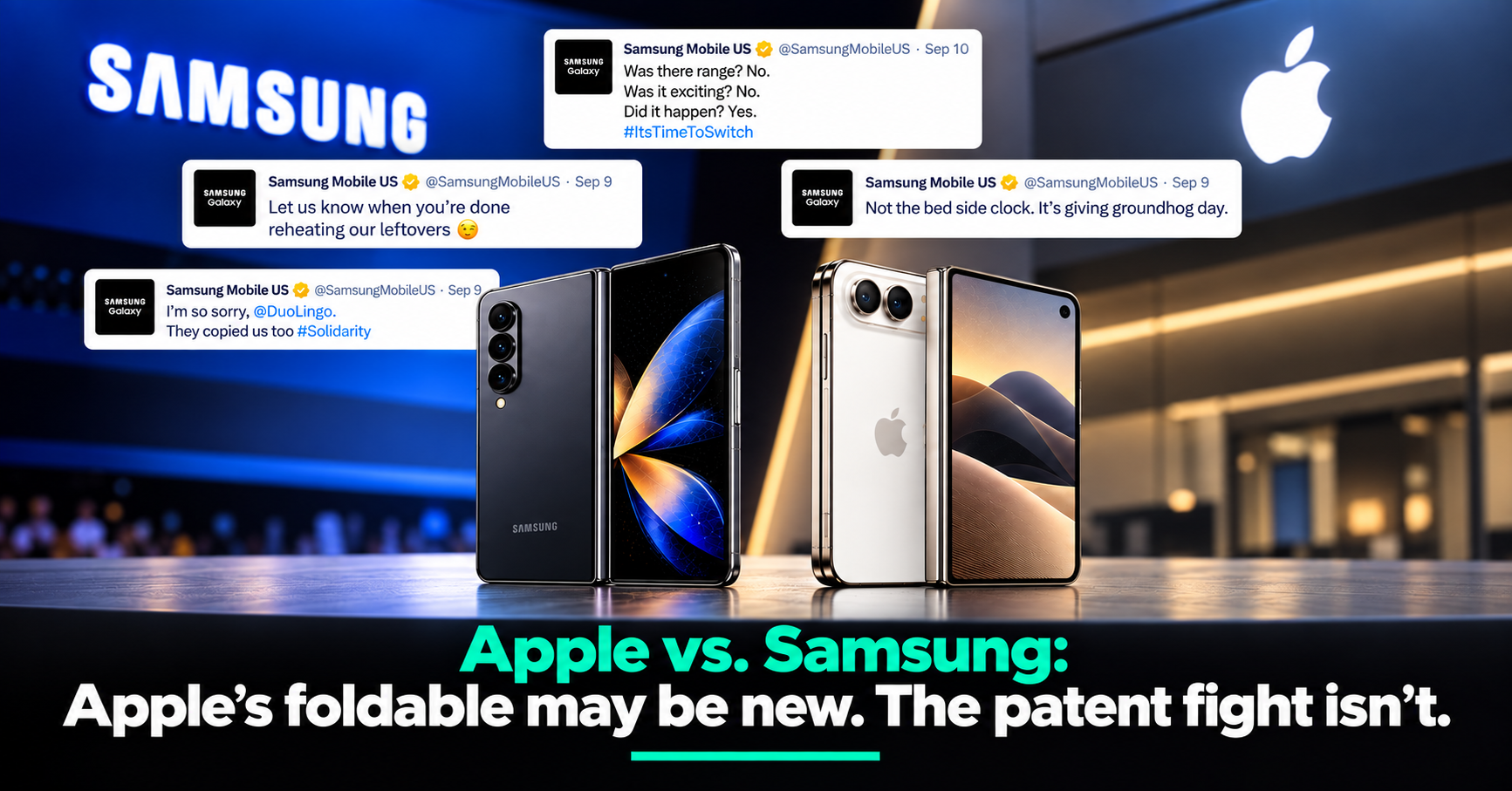
Apple launched the iPhone Duo on 9 September. Samsung’s social team went after them the same day.
Key takeaways
- Apple filed US 8,787,016 on 6 July 2011
- The Galaxy Fold went on sale in September 2019
- In December 2020 an examiner cited that patent against a Samsung application
- Apple kept the family alive through seven filings to 2024
“Let us know when you’re done reheating our leftovers”
“Making us wait? Fine. We’ll be over here, folding 3 ways.”
“So far, so same.”
This is the funny version of a very old argument. Apple and Samsung have been having it for fifteen years, and the early rounds were expensive. Roughly fifty cases in courts in several countries. A $539M verdict in May 2018. A settlement dismissed with prejudice a month later.
So we pulled the patent record. It does not support either side’s version.
Apple filed the blueprint in July 2011
US 8,787,016. Filed 6 July 2011. Granted in 2014. Calculated expiry in 2032.
Here is what it describes. Two housing portions connected by a hinge. A flexible display extending across the hinge. A device capable of folding face to face or back to back. Three bar and four bar linkage hinges. Rotational detents to hold the device at a selected angle. A bend radius of approximately 1 mm. In other words, the fundamental architecture of a foldable device was in Apple’s patent record as early as 2011.
The timing is also worth examining. Apple sued Samsung on 15 April 2011, alleging infringement relating to the iPhone. Samsung countersued within weeks. Then, in July 2011, Apple filed the foldable application. Three months into one of the most consequential smartphone IP disputes of the era, Apple was putting a foldable device into the patent record.
December 2020: an examiner put Apple’s patent in front of Samsung
This is where the story gets particularly interesting. Samsung Electronics filed application 16/824,438 in March 2020, titled “Foldable Display Device and Sound Providing Method Thereof.” On 14 December 2020, the examiner rejected claims 1, 13 and 14 under 35 U.S.C. §102(a)(1), citing Apple’s US 8,787,016 as prior art.
The office action mapped Samsung’s claimed elements against Apple’s 2011 disclosure, including the display panel, folding axis, lower member and output units. Samsung subsequently amended its claims, received a Notice of Allowance in March 2021, and the patent issued in July 2021 as US 11,054,857.
That is what normal prosecution looks like. Relevant prior art surfaces. Claims are amended. The applicant narrows or refines the scope. The application moves forward.
But there is an important detail here: The close prior art was Apple’s 2011 patent. And it was already nine years old when Samsung filed the application.
So what was Apple waiting for?
We searched Apple’s roughly 230 foldable families in our corpus for two problem areas.
| Problem area | Foldable families that mention it |
|---|---|
| Cover glass, cover windows or protective layers | About 95 |
| Crease, neutral axis, bending fatigue or cracking | About 53 |
The crease and fatigue filings are still climbing in 2025, the year before launch, and 2025 is not fully published yet. Fifteen years of filings, and a large share of them are not about making a phone fold. They are about whether it survives folding.
In June 2025, fifteen months before launch, Apple filed on a glass layer with a crack initiation load of at least 10 kgf, a bendable region of 200 microns or less, and ion exchange compressive stress regions.
That is not a concept sketch. That is a company that knows what it is about to build.
The fifteen year gap is the real story
Our corpus shows Samsung’s foldable display patent activity going back to the second half of the 2000s. Samsung’s first foldable smartphone went on sale in September 2019. Apple’s foundational foldable disclosure dates to July 2011. Its product is shipping in October 2026.
Different companies. Different decades. But the same lesson:
There is a long distance between patentable and manufacturable.
That gap is easy to underestimate. Samsung unveiled the Galaxy Fold on 20 February 2019. After review units experienced serious screen failures, commercial shipment did not begin until 6 September, a gap of 198 days. Apple announced its foldable on 9 September 2026 and plans to ship on 23 October. A gap of 44 days.
That does not mean Apple solved the engineering problem overnight. It suggests the engineering work happened much earlier, and that the patent record gives us clues about where that work was concentrated.
The part that applies to your own portfolio
Apple kept the 2011 application alive through seven filings:
- 2011
- 2014
- 2016
- 2018
- 2020
- 2022
- One lodged in October 2024 that is still pending
A patent filed in 2011 for a product that did not exist is worth nothing if you let the family die. Keep pointing the claims at the product as it takes shape, and a fifteen year old priority date ends up covering what you finally ship. It also shows up in your competitor’s office actions along the way.
So when you read a rival’s portfolio, stop counting filings. Do two things instead. Check which sub problem they are still filing on, because that is the one they have not solved. Then check whether they are still feeding their oldest families, because that tells you what they plan to build.
Run both with IP Author’s landscape report. The prosecution trail underneath it sits in IP Author.