
Most patent attorneys treat every Office Action the same way. Here's why examiner-specific intelligence (and AI tools grounded in real prosecution data) is the strategy that's actually moving the needle on allowance rates in 2026.
Let me tell you about a conversation I keep hearing at IP conferences and in patent attorney forums right now. It goes something like this: "We added an AI drafting tool last year. Our output is faster, but our allowance rate hasn't really moved." Sound familiar?
It should, because faster isn't the same as smarter. And in 2026, with the USPTO itself deploying artificial intelligence to shape how examiners review applications, prosecuting patents the same way you did three years ago isn't just inefficient. It's a strategy mismatch.
The attorneys and firms who are genuinely improving their allowance rates right now are not simply using AI to write faster responses. They're using prosecution intelligence (real, examiner-specific data) to write the right response. There's a meaningful difference, and this post is going to walk you through it.
We're going to cover what's actually changed at the USPTO, why the average patent application still averages 2.4 examiner actions before final disposition, what examiner intelligence really means in practice, and how tools like IP Author let you use that data to prosecute more effectively from day one.
The current landscapeThe Ground Has Shifted: And Most Prosecution Workflows Haven't Caught Up
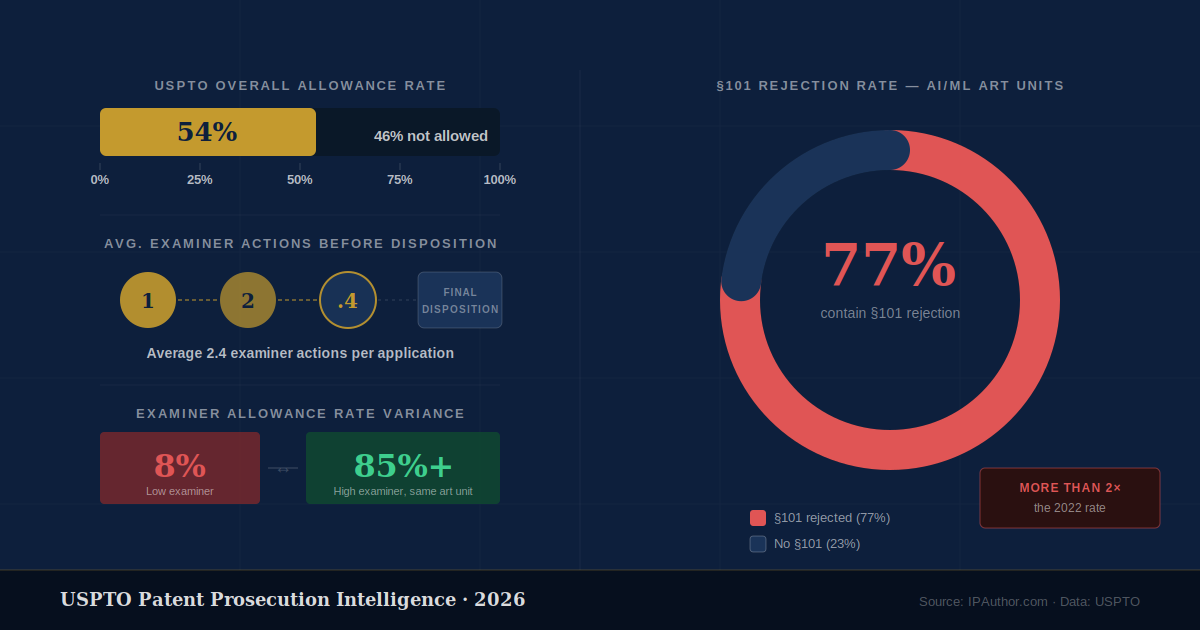
Here's something worth sitting with: the USPTO's overall allowance rate sits around 54%. That means nearly half of all applications filed don't ultimately become patents. Drill down into technology-dense art units (software, AI, machine learning) and the stakes sharpen in AI art units. In Working Group 2120, which handles AI and ML patents, 77% of Office Actions contain a §101 rejection, more than double the rate from 2022.
That's not a drafting problem. That's a strategy problem.
At the same time, the USPTO has been quietly rolling out its own AI infrastructure. The ASAP! program (their AI Search Automated Pilot) now surfaces prior art references through automated search before a human examiner has even opened your application. ASAP! is a limited-enrollment pilot program for now. But the signal is clear: AI-assisted prior art search upstream of the human examiner is the direction the Office is moving.
The first Office Action your client receives has increasingly been shaped upstream by AI systems trained to find problems with applications. If your prosecution strategy doesn't account for that shift, you're preparing for a fight using last decade's playbook.
Most firms responded to the AI wave by investing in drafting and response-generation tools. That's a reasonable first move. But there's a second move (the one that actually changes outcomes) and a lot of practitioners are still waiting to make it.
The variance behind the averageWhy 2.4 Examiner Actions Is Not a Fixed Number
The average patent application generates 2.4 examiner actions before reaching final disposition. That is the current baseline. But averages hide enormous variance, and the variance is not random.
An examiner with an 8% allowance rate in an art unit where colleagues average above 85% does not approach prosecution the same way as those colleagues. An examiner who has allowed 400 applications in your technology space has shown you, through their actions, exactly what claim language and arguments work for them. An examiner who consistently piles § 103 rejections onto every first action is telling you something important about how to draft your initial claims, not just how to respond.
The problem is that most attorneys treat examiner assignment like weather: something that happens to you, not something you can anticipate or prepare for. But examiner data is public. Prosecution histories are public. The patterns are there if you have the infrastructure to read them at scale.
Here's the honest reality: a practitioner with good examiner intelligence going into a prosecution can often cut that 2.2 Office Action average significantly. Not by gaming the system, but by understanding it. Filing claims structured around what your specific examiner has historically allowed, raising the arguments that have moved them in comparable cases, knowing whether requesting an interview is likely to accelerate or slow things down. That's not guesswork. That's data-driven prosecution.
Beyond allowance rateWhat Examiner Intelligence Actually Means (Beyond Allowance Rate)
When most people talk about examiner data, they're thinking about allowance rate. That's the entry-level metric (and it's useful) but it barely scratches the surface of what meaningful prosecution intelligence looks like.
Here's what actually matters:
An examiner with a 40% allowance rate who fires § 103 rejections 80% of the time is a fundamentally different prosecution challenge than one with the same allowance rate who defaults to § 101. The amendment strategy, the argument structure, even the claim scope decisions you make at the outset, all of it shifts depending on which weapon your examiner tends to reach for first.
Some examiners draw heavily on domestic patents. Others cite foreign references or non-patent literature regularly. Knowing this ahead of time shapes how you prepare your prior art response and whether you need deeper international landscape analysis before you file.
Examiner interview data is one of the most underused prosecution intelligence signals available. Some examiners have a strong track record of allowing cases after interviews. Others (and this is documented in prosecution histories) rarely change positions after an interview. Requesting an interview with the latter is not a waste of time so much as it is a misallocation of it. Knowing which situation you're in changes how you sequence your prosecution strategy.
This is where prosecution intelligence gets genuinely actionable. If you can see the cases a specific examiner has allowed (not just the count, but the actual claims and the arguments made) you can identify patterns in what language resolved their objections. That's not copying prior applications. That's understanding what the person reviewing your case responds to, and structuring your response accordingly.
IP Author's platform tracks over 16 million applications. When you pull examiner intelligence for a specific art unit, you're not getting a summary statistic. You're getting a prosecution map (rejection patterns, argument history, claim-level analysis) that tells you what to expect and how to prepare before you ever see the first OA.
The § 101 Problem Has Not Gone Away: It's Gotten More Complicated
Let's talk about § 101 specifically, because it deserves its own section. Abstract idea rejections under § 101 remain the most unpredictable and frustrating category in patent prosecution. And 2026 hasn't made that better, it's made it more complicated.
The USPTO issued updated §101 guidance for AI inventions in August 2025, aimed at standardizing how abstract idea rejections are applied across art units. In theory, that guidance should create more consistency. In practice, examiner-to-examiner variance on §101 rejections remains wide, and the guidance has not yet produced the uniformity practitioners were hoping for.
What that means for prosecution strategy: you cannot treat § 101 rejections as a generic category. You have to know how your specific examiner has handled abstract idea challenges in comparable technology cases. An examiner who has allowed software method claims when they were tethered to specific hardware constraints is telling you something specific about how to structure your response to a § 101 rejection. An examiner who has never allowed a pure software method claim on the basis of abstract idea arguments alone is telling you something else, probably that you need to consider claim amendments rather than pure argumentation.
This is not information you can derive from reading the MPEP more carefully. It lives in prosecution histories. And in 2026, you need a platform that surfaces it automatically rather than requiring you to manually excavate it from Public PAIR.
Two attorneys, one OAHow the Modern Prosecution Workflow Actually Looks Different
Let me describe two patent attorneys responding to the same first Office Action in the same art unit. Both are capable. Both have solid experience. The difference is in the information they're working with.
Attorney A opens the OA, reads the rejections, pulls the cited references, drafts arguments addressing the rejections, and files a response. It's thorough. It's professional. It's also identical in structure to how they've handled every other OA for the past decade.
Attorney B does all of that, but before drafting the response, they pull the examiner's prosecution profile. They see that this examiner allows 58% of applications in this art unit, that 71% of their first actions cite § 103 rejections (which matches this case), and that in roughly 12 of the last 15 comparable cases, allowance came after applicant added a functional limitation to the independent claim and requested an interview. Attorney B structures the response accordingly. They get to allowance in one more OA instead of two.
That's not a dramatic story. It's a quiet, systematic advantage that compounds across every case in a portfolio. And it is completely accessible to any practitioner using the right prosecution intelligence platform.
Want to see this in action? Pull your examiner's prosecution profile: rejection breakdown, interview effectiveness, and historical claim language that moved the needle.
Free at insights.ipauthor.com →The Disclosure Question Every Firm Using AI Needs to Answer
If you're using AI tools in your prosecution workflow (and in 2026, you almost certainly are) there is an emerging compliance question you need to be on top of: the USPTO's guidance around disclosure of material AI involvement in patent application preparation.
The rules are still evolving. But the trajectory is clear: attorneys using AI tools throughout drafting and prosecution will increasingly be expected to document that involvement and maintain clean, attorney-supervised workflows. This isn't a reason to pull back from AI. It's a reason to use platforms that are built for attorney supervision rather than autonomous generation, platforms where the attorney is directing the analysis, reviewing the output, and making the legal judgments.
There's also a practical risk dimension here. General-purpose AI tools have a documented tendency to hallucinate case citations and fabricate prior art references. In a patent prosecution context, that's not just embarrassing, it can create real professional liability exposure. Purpose-built patent prosecution platforms with verified citation workflows are a different category than general AI assistants, and that distinction matters more every year.
The platformWhat IP Author's Prosecution Intelligence Platform Does Differently
IP Author was built on a core premise: that the information to prosecute more effectively already exists in the patent record. The issue is accessibility and scale. Sixteen million applications worth of prosecution history is not something a practitioner can manually analyze. But it is something a purpose-built platform can index, surface, and make actionable.
Here's specifically what that looks like in practice:
Real-time allowance rates, rejection breakdown by statute section (§ 101, § 102, § 103), prior art sourcing patterns, and interview effectiveness rates, for your specific examiner, not art unit averages.
Response strategies generated from your examiner's actual precedent, not generic legal frameworks. The system identifies cases your examiner has allowed in comparable technology spaces and extracts the claim language and argument structures that worked.
Track application status across your entire docket, receive alerts on new Office Actions, and spot patterns across multiple examiners or art units before they become portfolio-level problems.
Run a comprehensive search before your examiner does, using the same breadth of coverage that the USPTO's ASAP! program surfaces, so you're not surprised in the first OA.
IP Author's insights platform at insights.ipauthor.com gives practitioners access to examiner data and OA analysis without a full platform commitment, a strong starting point if you want to see what examiner-level data actually looks like before going deeper.
The core argument here is simple: the USPTO has AI tools working against your application. You should have AI tools working for it. And the most effective version of those tools is not one that drafts faster, it's one that helps you understand the specific examiner reviewing your case and respond to them specifically.
A data point worth flaggingA Note on RCE Filings: What the Drop in Them Tells Us
One data point worth flagging: RCE filings are at multi-year lows heading into mid-2026. That's a meaningful signal. For a long time, RCEs were the default response to a prosecution stall, pay the fee, keep the application alive, try again. But with escalating RCE costs and the USPTO's fee structure making continued prosecution increasingly expensive, applicants are making different choices. More appeals. More targeted amendments designed to resolve cases in fewer rounds. More abandonment of applications that were never going to be strong grants anyway.
This shift reinforces the core argument for prosecution intelligence. If you're going to resolve cases in fewer OA rounds (whether by design or economic pressure) you need to be more precise from the first response. The margin for 'let's see what they say after the next round' has narrowed. The premium on getting the response right the first time has increased.
What to rememberStart With the Data You're Currently Missing
The prosecution intelligence that moves allowance rates isn't hidden. It's in sixteen million application histories, waiting to be read at scale. IP Author's platform makes it accessible, actionable, and fast, so your next OA response is built on what actually works for your specific examiner, not what works on average.
Explore IP Author's Free Prosecution Intelligence Tool
No commitment required. Pull examiner data for your next active application and see what prosecution intelligence actually looks like in practice.