
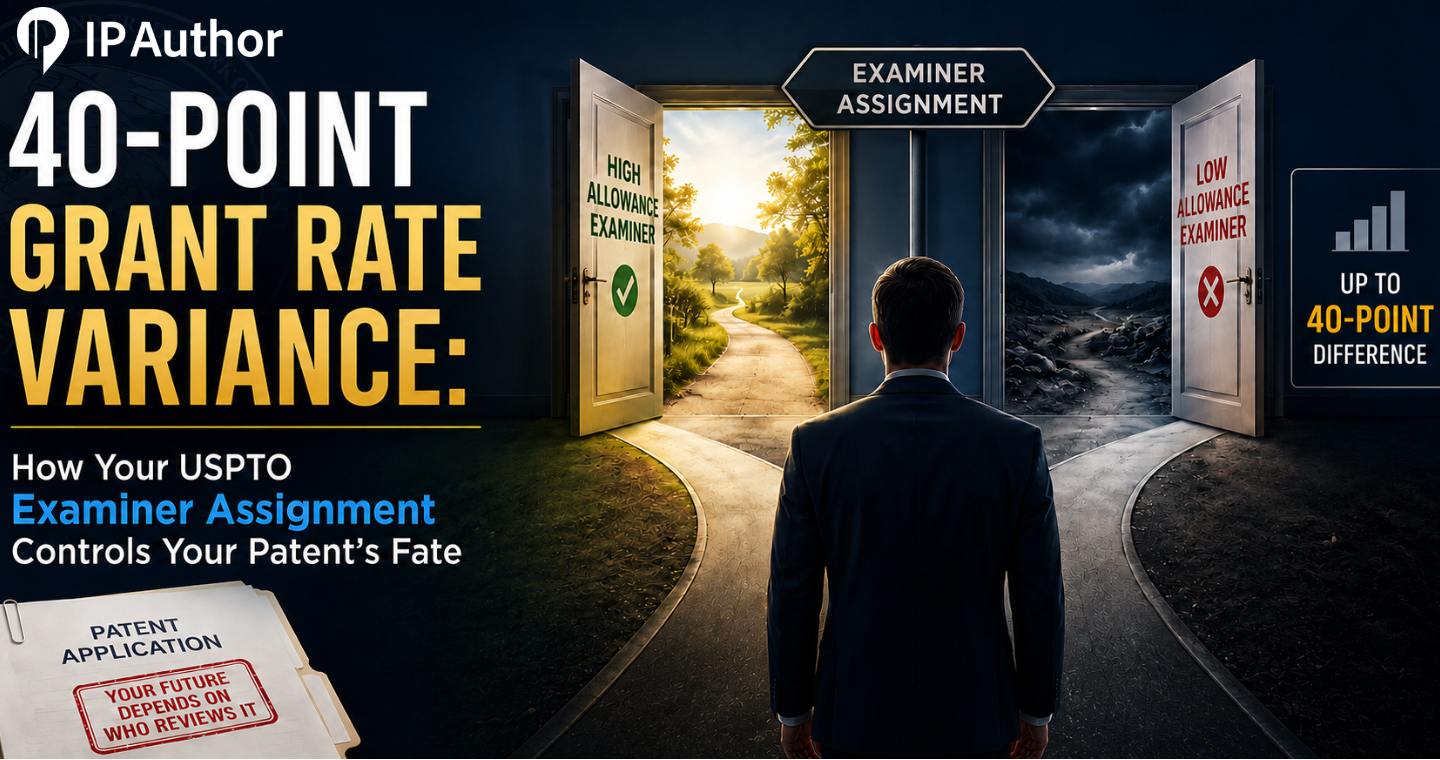
With 889,280 US AI patent families and generative AI filings surging 43% year-over-year, the examiner assigned to your case has never been more critical to understand. Studies show allowance rates vary by more than 40 percentage points depending solely on examiner assignment.
Patent prosecution has always been part art, part science. In 2026, the science is winning. Practitioners who enter a prosecution cycle without knowing their examiner's grant rate, rejection patterns, allowance-after-interview rate, and technology familiarity are flying blind. IP Author's Examiner Intelligence platform changes that by turning 179 million patent publications into actionable examiner profiles.
Why it matters1. Why Examiner Intelligence Is the Competitive Edge of 2026
The USPTO employs approximately 9,009 patent examiners (USPTO FY2025 Performance and Accountability Report) across hundreds of art units. Each carries a distinct profile: a personal grant rate, a preferred rejection statute, a typical prosecution timeline, and a track record of how often they allow claims after an interview. These differences are not small.
Studies consistently show that an applicant's chances of allowance can vary by more than 40 percentage points depending solely on which examiner is assigned (Frakes & Wasserman, "Examiner Characteristics and the Patent Grant Rate," 59 Journal of Law and Economics 49, 2016). That variance has nothing to do with claim quality and everything to do with examiner behavior. In a world where prosecution costs can reach tens of thousands of dollars per application, understanding your examiner before drafting your first office action response is a core strategic advantage.
The urgency is amplified by technology. Artificial intelligence, generative models, quantum computing, and autonomous systems are flooding the USPTO with filings that many examiners have never seen before. An examiner's comfort level with a technology class directly influences how they apply prior art and eligibility doctrine. That is precisely why examiner intelligence has moved from a nice-to-have tool to a first-call resource in 2026.
Filing volumes2. The AI Patent Explosion: What Examiners Are Seeing Every Day
The numbers from IP Author's corpus tell a striking story. Among US patent families touching artificial intelligence and machine learning, the database contains 889,280 distinct family-deduped inventions. That figure represents unique innovations, not redundant filings, making it one of the most accurate measures of genuine AI inventive activity available anywhere.
| Year | US AI and ML Patent Families | Year-over-Year Change |
|---|---|---|
| 2021 | 32,663 | Baseline |
| 2022 | 40,930 | +25.3% |
| 2023 | 42,381 | +3.5% |
| 2024 | 49,864 | +17.7% |
| 2025 | 68,358 | +37.1% (109% total growth since 2021) |
Source: IP Author patent corpus, 179M global publications, extended-family deduplication applied.
From 2021 to 2025, US AI patent families grew by 109 percent. The 2025 spike of 37 percent in a single year coincides with mass adoption of large language models and foundation model architectures. Examiners in art units covering G06N, G06F, and related CPC classes are absorbing an unprecedented volume of new filings.
GenAI trends3. Generative AI and LLMs: The Fastest-Growing Examination Category
If the broad AI/ML filing numbers are dramatic, the generative AI and LLM figures tracking nearly in parallel demands explanation. IP Author measures these via two distinct but heavily overlapping search tracks: the AI/ML filter captures neural networks, machine learning systems, and statistical inference broadly; the GenAI and LLM filter targets large language models, foundation models, diffusion architectures, and generative adversarial networks specifically. The near-equal totals reflect a well-documented structural shift - by 2023, the overwhelming majority of new AI/ML patent filings involve generative architectures. These are parallel descriptors of the same filing wave, not additive independent counts. The overlap confirms that contemporary AI/ML prosecution is now almost entirely generative in character, a signal that shapes every G06N examiner's daily workload in 2026.
| Year | Generative AI and LLM Patent Families (US) | Change |
|---|---|---|
| 2021 | 28,829 | Baseline |
| 2022 | 36,902 | +28.0% |
| 2023 | 39,215 | +6.3% |
| 2024 | 47,254 | +20.5% |
| 2025 | 67,729 | +43.3% (largest single-year surge on record) |
Source: IP Author patent corpus, extended-family deduplication applied.
IBM alone holds 25,246 families in the generative AI space, followed by Microsoft at 15,150, Samsung at 9,434, and Alphabet at 7,334. The primary CPC zones cluster in G06N with secondary classifications in H04L and G06Q.
Prosecution Alert: Examiners assigned to generative AI applications are simultaneously managing the highest volume growth and the most legally unsettled eligibility landscape. Understanding whether your examiner tends toward broad Section 101 rejections or engages substantively with the claims is a critical input to your claim-drafting and amendment strategy.
4. Autonomous Vehicles: A Crowded Art Unit Battlefield
The autonomous vehicle sector represents another category where examiner intelligence is decisive. IP Author's corpus shows 82,719 US patent families published in 2025 across autonomous vehicle and self-driving technology (IP Author corpus; primary CPC subclasses B60W, B60R, G05D, G08G, and related AV classifications; cross-family deduplication applied), making it one of the most contested technology spaces at the USPTO.
| Rank | Company | Autonomous Vehicle Patent Families |
|---|---|---|
| 1 | Toyota Motor Corporation | 33,352 |
| 2 | Samsung Electronics | 27,469 |
| 3 | Ford Motor Company | 23,883 |
| 4 | General Motors | 23,793 |
| 5 | Honda Motor | 19,374 |
| 6 | Hyundai Motor | 18,664 |
| 7 | Robert Bosch GmbH | 15,206 |
| 8 | Denso Corporation | 15,082 |
Source: IP Author patent corpus, all years combined, extended-family deduplication.
§101 strategy5. The Section 101 Landscape: Software Patents Under Pressure
No discussion of examiner intelligence in 2026 is complete without addressing Section 101 patent eligibility. IP Author's analysis shows 22,222 US patent families in the software and abstract-idea-adjacent space were published in 2025 (IP Author corpus; G06F and related abstract-idea-adjacent CPC classifications; cross-family deduplication applied), up from 17,975 in 2024, a 24 percent increase.
| Technology Area | 2024 Families (US) | 2025 Families (US) | Growth |
|---|---|---|---|
| AI and ML Overall | 49,864 | 68,358 | +37.1% |
| Generative AI and LLMs | 47,254 | 67,729 | +43.3% |
| Autonomous Vehicle | 61,267 | 82,719 | +35.0% |
| Software and Abstract Idea | 17,975 | 22,222 | +23.6% |
Source: IP Author patent corpus, US publications, extended-family deduplication.
IBM leads the software-adjacent prosecution activity with 12,953 families, followed by Microsoft at 7,451, Dell Technologies at 5,168, and Intel at 4,285. The Section 101 landscape is examiner-dependent to a degree most practitioners still underestimate. Within the same art unit, two examiners can apply the Alice-Mayo framework with materially different thresholds. IP Author's examiner profiles reveal each examiner's historical ratio of 101 rejections to allowances - and that ratio is the single highest-leverage data point available before drafting an office action response.
The 2026 §101 Prosecution Playbook: What Examiner Data Reveals
Alice-Mayo has not changed since 2014, but the USPTO's internal application has evolved materially. The 2019 Revised Patent Subject Matter Eligibility Guidance - still operative in 2026 - restructured the analysis around Step 2A Prong 2: whether a claim integrates a judicial exception into a practical application. Examiners vary dramatically in how they apply this prong, and that variance is measurable at the individual level through IP Author's examiner profiles.
Examiners with high §101 rejection rates characteristically frame abstract ideas in broad, reductive terms: "processing data," "mathematical relationships," "mental processes." If your examiner's profile shows a §101 rejection rate above 30% in AI art units, draft independent claims that foreground the physical or computational substrate - not merely the mathematical operation - before the first office action arrives. Front-loading structural specificity costs nothing; retrofitting it after a broad Prong 1 rejection costs weeks and billable hours.
Surviving §101 in 2026 requires three things working together: (1) a specific technical improvement documented in the specification - reduced inference latency, improved classification accuracy with the claimed architecture, lower memory overhead - not merely a benefit stated in abstract terms; (2) structural and functional specificity in claim language - not "a processor configured to process" but the specific transformation applied to specific input yielding a specific technical output; and (3) a clear distinction from generic computer implementation showing the method cannot be performed mentally or on paper. The Enfish v. Microsoft (CAFC 2016), McRO v. Bandai Namco (CAFC 2016), and Core Wireless v. LG Electronics (CAFC 2018) lines remain the strongest templates for software-related §101 arguments in 2026.
An examiner with a §101 rejection rate above 35% in AI art units warrants a claim-drafting strategy built around Prong 2 from filing: structural limitations, explicit technical-effect language, and specification sections that describe "how" the invention works, not only "what" it does. An examiner below 15% may be primarily a prior-art responder, making interview efficiency far higher on §102/§103 grounds. IP Author surfaces each examiner's §101-to-total-rejection ratio alongside grant rate and prosecution timeline, giving practitioners a pre-response blueprint rather than a reactive posture.
6. Who Is Shaping Examiner Workloads: Top Patent Filers
Companies that file at very high volume effectively train examiners through repeated interaction. Their claim formats, argument styles, and interview practices become familiar to examiners who see them constantly. Here are the top filers in the US AI and machine learning space.
| Rank | Company | US AI and ML Patent Families |
|---|---|---|
| 1 | IBM (International Business Machines) | 22,741 |
| 2 | Intel Corporation | 14,739 |
| 3 | Microsoft Corporation | 11,324 |
| 4 | Samsung Electronics | 7,457 |
| 5 | Siemens AG | 6,992 |
| 6 | General Electric | 6,983 |
| 7 | Caterpillar Inc. | 6,736 |
| 8 | Alphabet (Google) | 6,105 |
| 9 | Robert Bosch GmbH | 6,065 |
| 10 | Dell Technologies | 5,915 |
Source: IP Author patent corpus, US AI/ML patent families, all years, extended-family deduplication.
IBM's lead of 22,741 families is nearly 55 percent larger than Intel's second-place 14,739. Examiners who routinely handle IBM applications have developed nuanced expectations around functional claiming, means-plus-function interpretation, and computer-implemented method structures that influence how they read all applications in their art unit.
The platform7. How IP Author's Examiner Intelligence Platform Works
IP Author aggregates prosecution data from US patent filings and cross-references it against its 179-million-publication global corpus to build a dynamic examiner intelligence layer. Every examiner profile reflects real prosecution outcomes, not modeled predictions.
| Grant Rate Analysis | Individual grant rates for every US examiner, broken down by technology class and recent filing year to reflect current behavior rather than historical averages. |
| Rejection Statute Mix | The proportion of 102, 103, and 101 rejections each examiner issues and how that mix has evolved as USPTO guidance has changed. |
| Prosecution Timeline | Average pendency from filing to first office action and from first action to allowance, at the individual examiner level, so you can set realistic client expectations. |
| Interview Allowance Rate | How often each examiner allows claims after a formal examiner interview, a direct signal of whether an interview is worth requesting and how to frame the interview agenda. |
| Head-to-Head Comparison | Side-by-side comparison of two examiners across all prosecution metrics, useful when managing a portfolio spread across multiple art units or evaluating appeal risk. |
| Prior Art Corpus Access | Every examiner profile is backed by the full 179M-publication corpus so you can explore the prior art universe your examiner is searching before you file your response. |
8. Turning Examiner Data Into Prosecution Strategy
Data is only as valuable as the strategy it enables. Here is how forward-thinking practitioners are using IP Author's Examiner Intelligence in 2026.
Identify the most likely art units for the application and review the grant rate distribution across examiners within those units before claims are finalized.
If assigned examiners in the target art unit have a high rate of 101 rejections, draft independent claims with explicit structural limitations and functional nexus language from the start.
Once an examiner is assigned, run a full profile: grant rate, rejection statute mix, prosecution timeline, and interview allowance rate. Share the profile summary with the client alongside the filing acknowledgment.
Match the depth and tone of arguments to the examiner's history. A high-interview-allowance examiner warrants an interview request alongside any written response.
Use head-to-head comparison to benchmark examiners across a portfolio and identify which pending applications are at statistical risk for extended pendency or final rejection.
9. Conclusion: The Examiners Have Changed. Has Your Strategy?
The data from IP Author's 179-million-publication corpus is unambiguous. US patent examiners in 2026 are managing an unprecedented volume of AI, generative model, autonomous vehicle, and software patent applications. From 2021 to 2025, US AI patent families grew by 109 percent. Generative AI filings jumped 43 percent in a single year. The autonomous vehicle space produced 82,719 US families in 2025 alone.
Examiners are not a neutral variable in this environment. They are a primary driver of prosecution outcomes, and their individual behavior is measurable, predictable, and actionable with the right tools.
Data sourced from the IP Author patent corpus (179M+ global publications, updated June 2026). All family counts are extended-family deduped representing distinct inventions. Copyright 2026 IP Author. All rights reserved.
Explore IP Author's Free Prosecution Intelligence Tool
No commitment required. Pull examiner data for your next active application and see what prosecution intelligence actually looks like in practice.